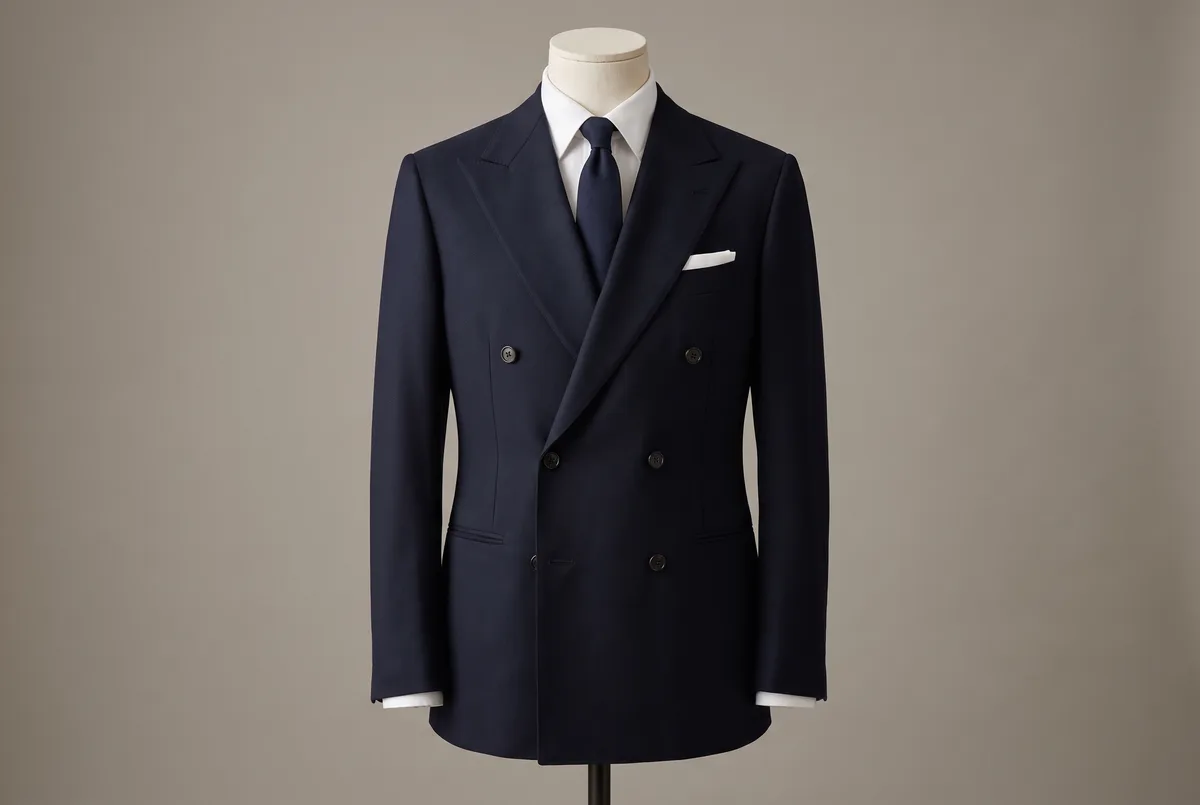
Most men stop at the same place in front of a double-breasted suit. They want to wear one, and then the questions start. Am I too young for it? Will it look out of place in my position? And does it read as dated now?
There is a plain answer. Whether a double-breasted suit is right for you is decided by neither age nor rank. It is cloth and fit. I have worn one since my late twenties, and I have rarely seen anything else make the difference.
And the word fit carries a misunderstanding of its own. Fit, in a double-breasted jacket, does not mean holding close to the body. It means where the room is placed, and how much of it goes there. That distribution is what gives the garment its presence.
The Same Question, Asked for Over a Decade
What men worry about with the double-breasted barely changes. How does it read when a man in his late twenties turns up in one? Is it odd to start at fifty? Is it something you may wear only once you reach the board? Can it be worn to interviews? The same question, in the same shape, has been put again and again for more than ten years.
The shape of the question does not change because the answers on offer never quite land for the man asking.
Explanations of which builds it flatters are not hard to find. Height gives you the vertical line; a lean frame gains depth through the chest. Being told this does not settle the matter, and the reason is that the question of build and the question of whether I may wear one in the position I hold now are two different things. Answer the first and the second is still standing.
So what follows is not about build. It is about what the man wearing it should actually check.
The answer was written down when the garment first came into wide use.
The Double-Breasted Closes the Centre With the Jacket Alone
Begin with what the garment is doing.
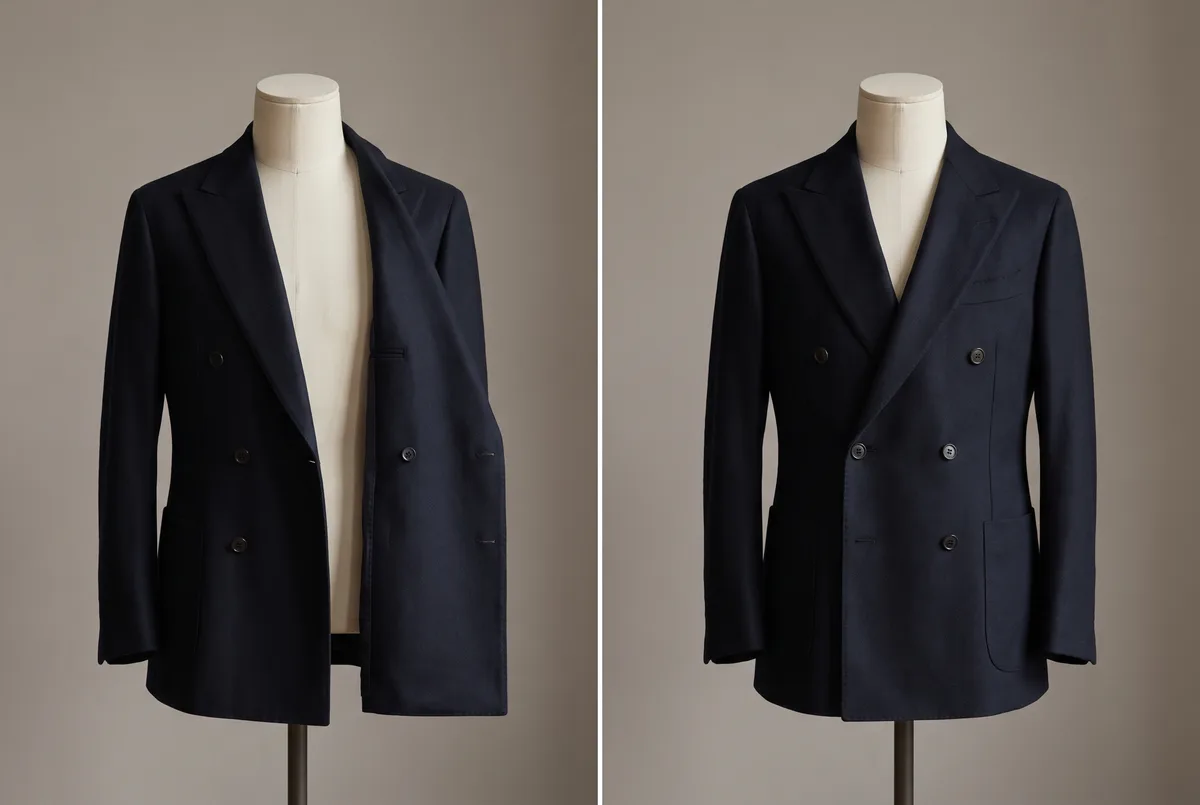
A double-breasted suit laps the fronts deeply across one another and fastens there. Two rows of buttons on the front. A single-breasted meets at a shallow angle with one row. The names describe the breast, not the buttons: in a double-breasted the front is doubled over itself. The rows are what you see. The lap is what the name is actually about.
The visible difference is the rows. The working difference is the depth of the lap.
Standing in dress is decided by how the centre of the body is handled. Open a jacket and the centre of the torso turns busy — shirt, tie and belt, three materials and three colours at the front of you. The three-piece suit closes that surface with a waistcoat in the same cloth. The double-breasted does the same thing with the jacket alone. It laps the fronts deeply and covers the torso with the doubled cloth itself. Not by adding a component, but through the structure of the coat — that is the thinking behind it. The depth of that lap is what I will call the overlap from here on.
The other thing is that a double-breasted almost always carries peaked lapels. You will find articles explaining that there is a technical reason it must be so. It does not appear in the primary record I have been able to consult. An 1897 manual written for working tailors in Britain — W. D. F. Vincent, The Cutter’s Practical Guide — says of single-breasted coats that the part of the turn beyond the crease row is “purely one of style”, and that “[t]his in no way affects the fit”. Read the chapter on the double-breasted and no exception to that is claimed either. Not a technical necessity, then, but an association that has held for a long time.
There is, though, one constraint particular to the double-breasted. The same manual notes that there is no lapel seam, so the cloth “cannot be manipulated at that part” — it cannot be drawn or shrunk there to build shape — and that many cutters therefore prefer a straighter cut. There is little margin for recovery. For the maker, a double-breasted is a garment that hides nothing.
The Room Is the Design, Not the Fault
The chief reason men keep away from the double-breasted is the impression that it looks bulky, or makes them look heavier. That mass is neither a failure nor a relic. From the earliest record we have, the garment was designed to carry room.
The drafting rules survive plainly in that manual. The overlap: “the addition of 2½ inches beyond the breast line is sufficient” — about 6.4 cm — but “sometimes this is increased to 3 or 3½ inches when the material is of a very heavy character” (about 7.6 to 8.9 cm). The heavier the cloth, the deeper the lap should run.
And then this. “This garment should not be made to fit too closely, its character demands a fair amount of ease”. A working tailor in 1897 was defining the character of the garment in those terms, and going on to specify how much ease to allow across the chest. The room was not what was left over. It was a design value from the start.
A tailor wrote that nearly 130 years ago. The answer I had arrived at over many commissions was to use cloth generously — which is why finding it already set down came as a surprise. Cut a double-breasted to close measurements and the garment thins out at once. The presence drains away.
So what men remember when they say it “looks baggy” is not the room itself. It is the memory of one suit where the room was distributed badly. Taking room away is not the way out. What to leave, and where to draw in — that is where the answer lies.
Presence Comes Down to Four Measurements
So how is that distribution decided? Failing and correcting narrowed it, for me, to four. When I commission a suit, I specify these four myself, without waiting to be asked.
Lapels at Ten Centimetres or More
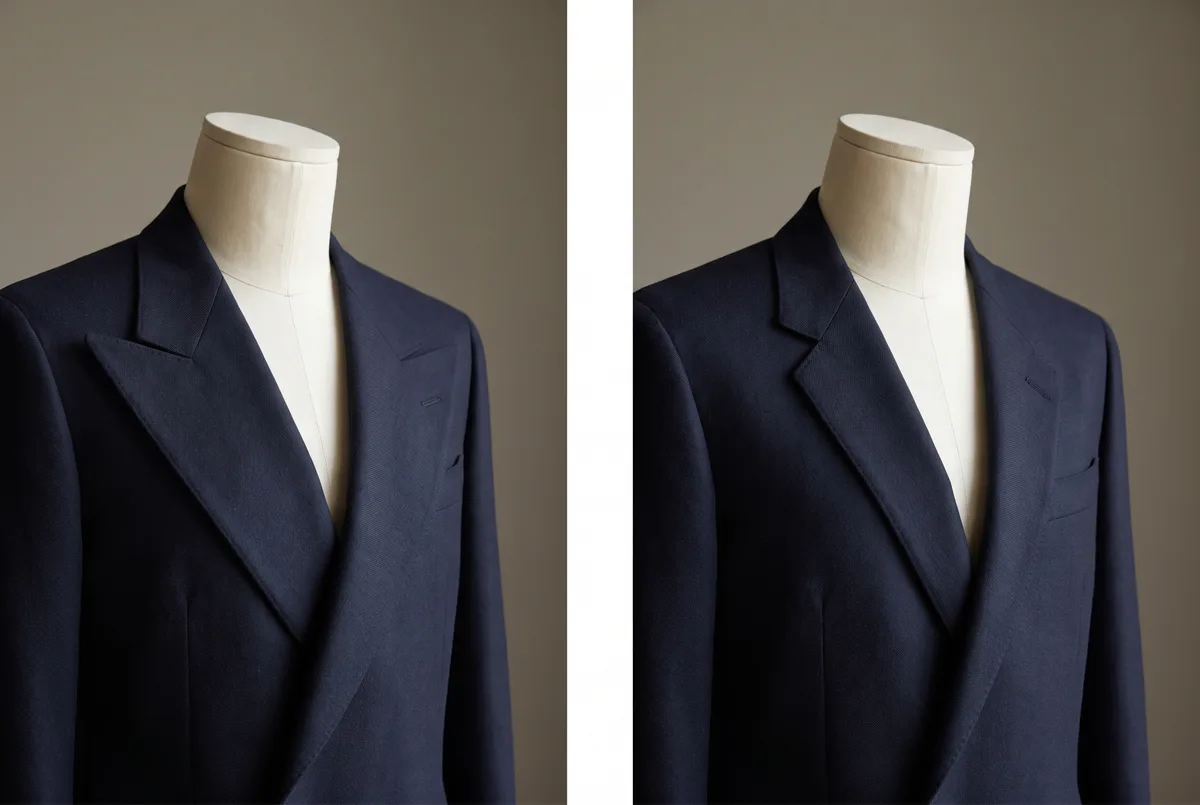
I once specified narrow lapels on a double-breasted. One look at the finished coat and I knew it was wrong. Nothing about the jacket was poor, and yet the presence had gone out of it.
The double-breasted lives on the breadth of surface that a deep lap creates. Set a narrow lapel on top of that and the upper body stops agreeing with itself. A narrow lapel on a double-breasted takes the presence down. This is not taste; it is proportion. Ten centimetres at the widest point, as a working minimum.
Take the Overlap Deep
Take the lap shallow and the V drawn by the lapels shrinks. A shallow V makes the chest read as closed up. A shallow overlap goes straight to looking graceless.
When the manual says to increase the lap for heavy cloth, this is the proportion it is talking about. I work from a slightly deep lap as standard. Lapping deep buys surface, and gives the V its height.
Length That Covers More Than Half the Seat
Short jackets have been the fashion of recent years. Cut a double-breasted short and its dignity collapses — the seat is left uncovered.
My mark is that more than half the seat is covered. It is a garment with a broad surface above, so the line running down needs a length to match. A short hem leaves the upper body to carry everything on its own, and the balance goes.
Suppress the Waist, but Only So Far
Having pressed the case for room, I do not mean that the waist goes unshaped. Without suppression there is no clean line. The room belongs to the surface, not to the outline.
What matters is the phrase “only so far.” Draw it in too hard and the deeply lapped fronts pull, and diagonal drag lines run across them. Because the lap is deep, a waist drawn in beyond reason shows itself honestly. Here again, the garment hides nothing.
Buying ready-to-wear changes none of the four. In the fitting room, measure the lapel against three fingers, and turn side-on to the mirror to see whether the hem covers more than half the seat. Those two alone will eliminate the ones that do not work.
Six Buttons, Fastened at One
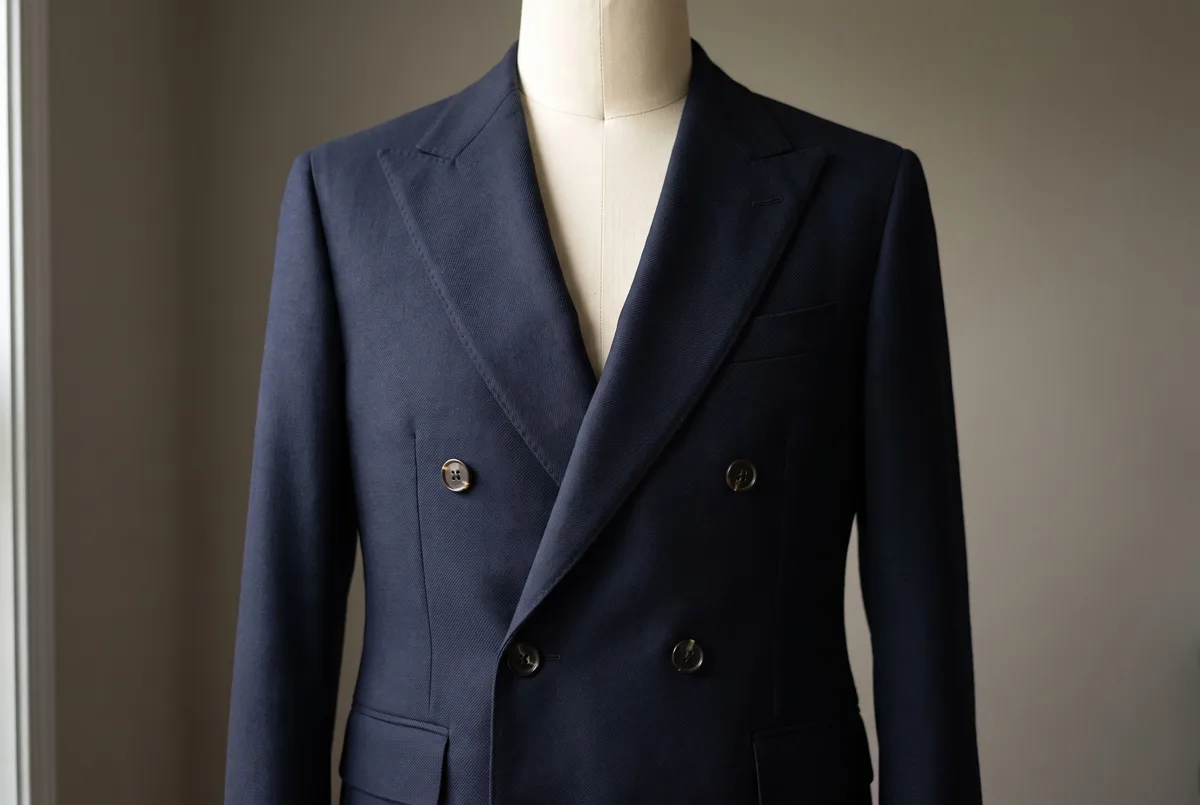
Separate from measurement, a word on how the buttons are arranged. The standard double-breasted carries six buttons on the front, and the impression turns on how many of them you actually fasten. Two is the most common. I choose six buttons fastened at one.
The reason is the V described above. Fastening lower stretches the lapel opening vertically and gives the chest height. On a double-breasted, where the surface above is broad, that vertical line does the work.
Whether a Double-Breasted Suits You Is Not About Age or Rank
Back, then, to the first question.
When someone feels that a man does not carry a garment well, what they are actually looking at is a shoulder that does not fit, a lapel that has thinned out, a hem cut too short. They call it “reaching above himself for his age”, but what they are seeing is the measurements, not the years. Show the same person a man in his twenties in a double-breasted that fits, and nothing catches.
I have worn this garment since my late twenties, and I do not recall ever being told I was too young for it. In the rooms abroad I have sat in, for what my own observation is worth, the cut is still doing its work.
What decides it is cloth and fit, not the wearer’s age and not his rank. That is my conclusion after many years in one.
So “once I reach the board” puts things in an order that has nothing behind it. Nor is there any ground for “better to wait while I am young.” The question is not your rank but whether the measurements of the coat in front of you are right. And measurements, unlike age, can be altered, though only so far and only in one direction; where that boundary falls is treated in the piece on suit size.
A word on cloth as well. The double-breasted is broad in surface and takes a good deal of material, so the quality of the cloth shows more honestly than it does on a single-breasted. Cheap, thin cloth simply reads as cheap across all that surface. If you are having one made, weight the budget towards choosing the cloth.
Choose It for the Rooms That Ask for Standing
The double-breasted is a garment of high standing. So I wear it without hesitation wherever standing is called for.
First introductions. Presentations that matter. Ceremonies.
And — this may seem unexpected — I choose it for an apology as well.
Let me be clear that what dress does in an apology is not to show you in a better light. What the other party is reading is how seriously you are taking the occasion. Dress says that before words do. Choosing a coat with nothing loose about it is nothing other than an expression of respect. Turning up to an apology dressed lightly speaks far more eloquently, and about something else entirely.
I do not hesitate over it at celebrations either. At a party it is, to my eye, about the best-looking thing a man can wear.
That said, standing high and suiting the room are not the same. The line drawn in the three-piece article applies here unchanged. Wear a double-breasted where the other party is plainly dressed down and what arrives is not respect but awkwardness. Whether to wear it is decided by looking at what the other man has on, not at your own rank, which is the whole argument of The Essence of the Suit.
Mourning dress is decided by a different set of principles, and is not treated here.
No Waistcoat
Men who like the three-piece tend to wonder whether adding a waistcoat to a double-breasted would raise it further. I would not. It adds bulk, and the bulk it adds cannot even be seen.
The double-breasted already carries the fronts in two layers. Add one more and there are three across the torso. The presence of this garment comes from breadth of surface, not from thickness. And a double-breasted is, to my mind, a coat worn fastened — and while it is fastened the waistcoat cannot be seen from outside. Set two components to the same task of closing the centre and the effect does not add up. Only the invisible bulk remains.
One preference of my own, while we are here. A single-breasted three-piece with the waistcoat alone made double-breasted — that is a device I have used for a long time. The coat keeps the lightness of a single-breasted, and the waistcoat that appears when it comes off draws the torso in with two rows of buttons. Borrowing the structure of the double-breasted, and putting it somewhere else.
The First One: Plain Navy
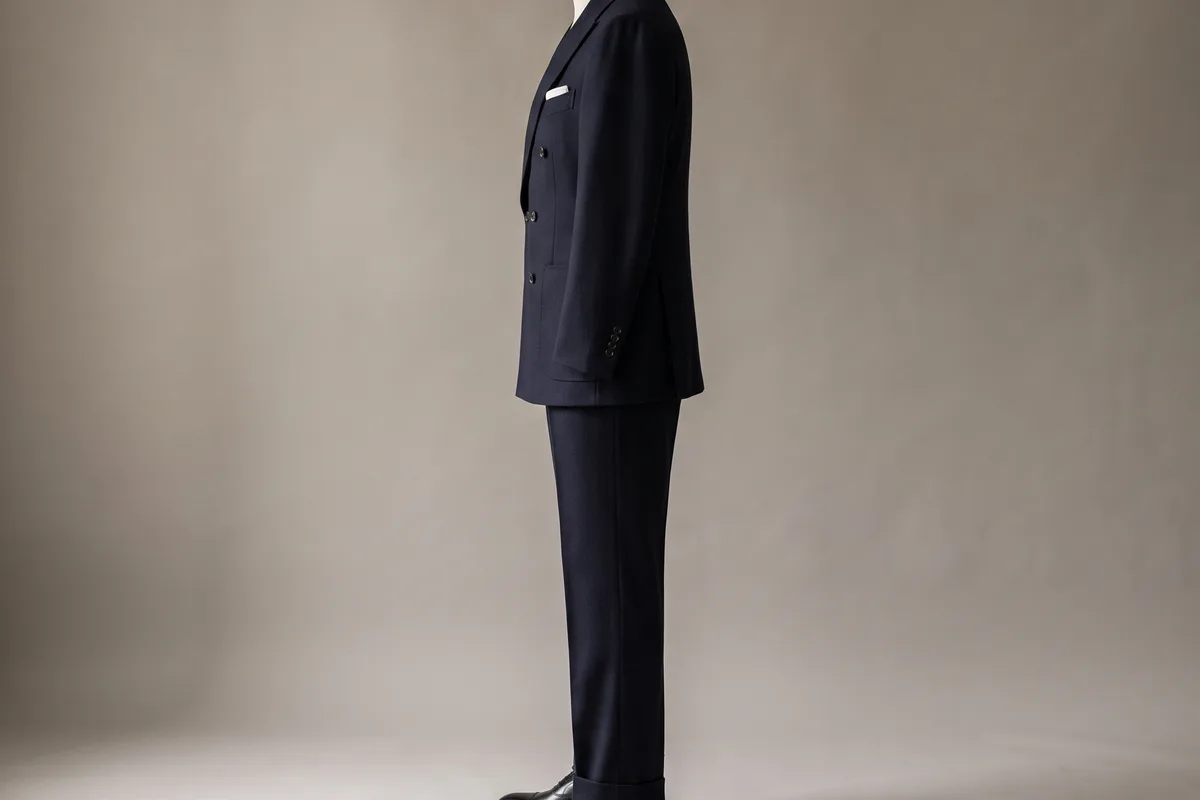
All of which comes down to a single suit.
Plain navy. Six buttons fastened at one. Lapels of ten centimetres or more. A hem covering more than half the seat. The overlap slightly deep, the waist suppressed but only so far. For cloth, a good wool with a closely woven surface. Wear it with a white shirt and closed-lacing shoes in a restrained finish.
Navy first because the colour does not pick its rooms. A first introduction, a presentation, an apology, a celebration — a navy double-breasted will not let you down at any of them. Pattern can wait for the second suit. The double-breasted puts a good deal of cloth out at the front, and a pattern laid across it sets the breadth and the pattern at odds with one another. Leave the first one plain, and let the surface itself do the talking.
And then there is the question of whether you can put the four measurements into your own words. Commissioned or bought off the rail, what separates a good double-breasted from a poor one is not the price of the cloth. It is that.
In Closing: If the Measurements Are Right, Any Age Will Do
Whether a double-breasted suits you is decided by neither age nor rank. What decides it is cloth and fit, and above all how the room is distributed.
From the earliest record we have, the garment was designed to carry room — exactly as a manual of nearly 130 years ago set it down: it “should not be made to fit too closely.” What turns that mass into presence is four measurements: the width of the lapel, the depth of the overlap, the length, and the suppression at the waist.
That I have been able to wear this garment since my late twenties owes nothing to my age and nothing to any position I held. The measurements were right, and that is all. Which is to say: get the measurements right and any age will do.
To a question asked for more than ten years, that is my answer.
The confidence you wear wins the game.
Frequently Asked Questions
It is not. The double-breasted is a garment of high standing, and I wear one without hesitation to first introductions, presentations and celebrations alike. Where it does look wrong, the cause is not the cut but the measurements. A narrow lapel, a short hem, a waist drawn in too hard — those disproportions are what surface as awkwardness.
Whenever standing is called for. First introductions, important meetings and presentations, ceremonies, and as a guest at celebrations. I choose it for apologies as well, since dress arrives before words and a coat with nothing loose about it reads as respect. Where the other party is plainly dressed down, however, it can be too much.
The cut itself has not dated. Its design is already recorded in an 1897 manual written for British tailors, which sets down that the garment should not be made to fit too closely — the character of it, room included, is on the page. It is a cut recorded nearly 130 years ago in the same terms we would use now. Where one does look graceless, the fault lies not in the cut but in the distribution of four measurements: lapel width, overlap, length and waist.
How the fronts are lapped. A single-breasted meets at a shallow angle with one row of buttons; a double-breasted laps deeply with two. In function, the double-breasted covers the centre of the torso with the lapped fronts themselves. What a three-piece does with a waistcoat, the double-breasted does through the structure of the coat alone.
I would not advise it. The double-breasted already carries its fronts in two layers, so a waistcoat puts three across the torso and adds bulk. And while the coat is fastened the waistcoat cannot be seen from outside. Set two components to the same task of closing the centre of the torso and the effect does not add up.