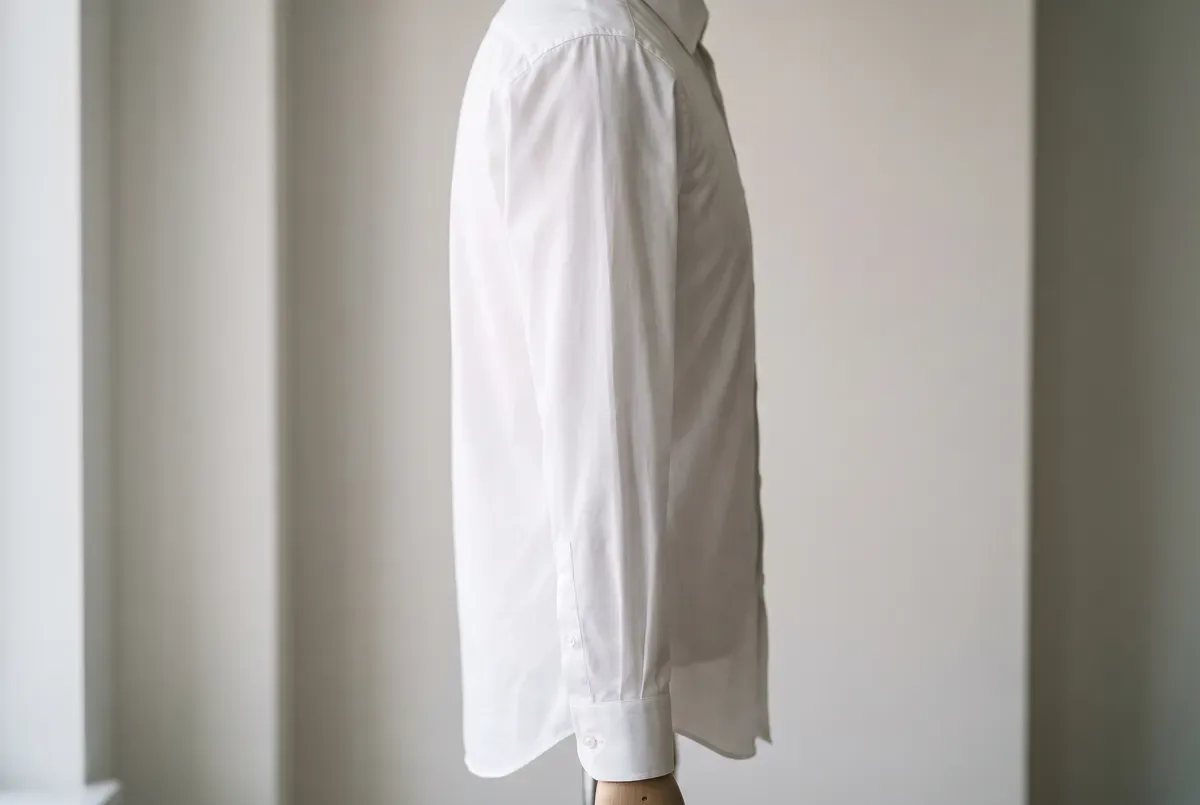
As the expression “talking with your hands” suggests, at work the hands, as they move, are often in plain view of the person across the table. The cuff sits just behind those hands. Seeing that the measurements are in order even that far adds, it seems to me, to the trust a man inspires.
On the sleeve, the account in The Essence of Dress Shirt Size settled the length, which alone can be altered afterwards, and left the choosing of the width to be dealt with separately. It stopped there. This piece takes up the side it handed over.
That width — the girth of a cuff — is settled with whatever has to fit inside it counted in.
More Than the Arm Goes Inside a Cuff
The arm is not all that goes into a cuff. A watch goes in as well. On the side where a thick watch is worn, the cuff needs girth enough to take that thickness too. The thickness of the wrist, with whatever sits in beside it added on — that is the girth of a cuff.
This girth is a measurement you choose. It belongs with what is already decided by the time a shirt comes off the rail. I said as much when writing The Essence of Dress Shirt Size. By the time a ready-to-wear shirt reaches the hand, its girth has been fixed already.
On the shop floor I paid particular attention to which wrist a customer wore his watch on, and how thick the watch was. Even when the two arms are alike in thickness, if a watch goes into one cuff only, the girth each cuff needs is not alike. The two cuffs will not necessarily come to the same measurement. On a shirt whose measurements could be drawn up for the customer, I made the left and right cuffs different in girth.
The same girth does not bring the same feel. Girth is a single quantity, but whether the hand actually passes through, and how the cuff looks once it is fastened, also depend on conditions that belong to the button: the length of the buttonhole; how stiff the buttonhole is; the length of the thread shank when the button is sewn on; the difference in tension between sewing by hand and sewing by machine. At the same measurement, these differences remain. Something similar happens with the cloth. Even at the same measurement, the firmness of the cloth and the way it is sewn change how the surplus shows beneath a jacket. Whether it bunches, or whether it turns tight. So on the shop floor, rather than decide on measurements alone, I recommended a shirt with the firmness of its cloth, and how it had been sewn, taken into account as well. The same thing happens with a collar. It runs along the same line as the way a shirt looks different once the collar style changes — The Essence of the Shirt.
Tightness Around the Arm Can Come From the Underarm
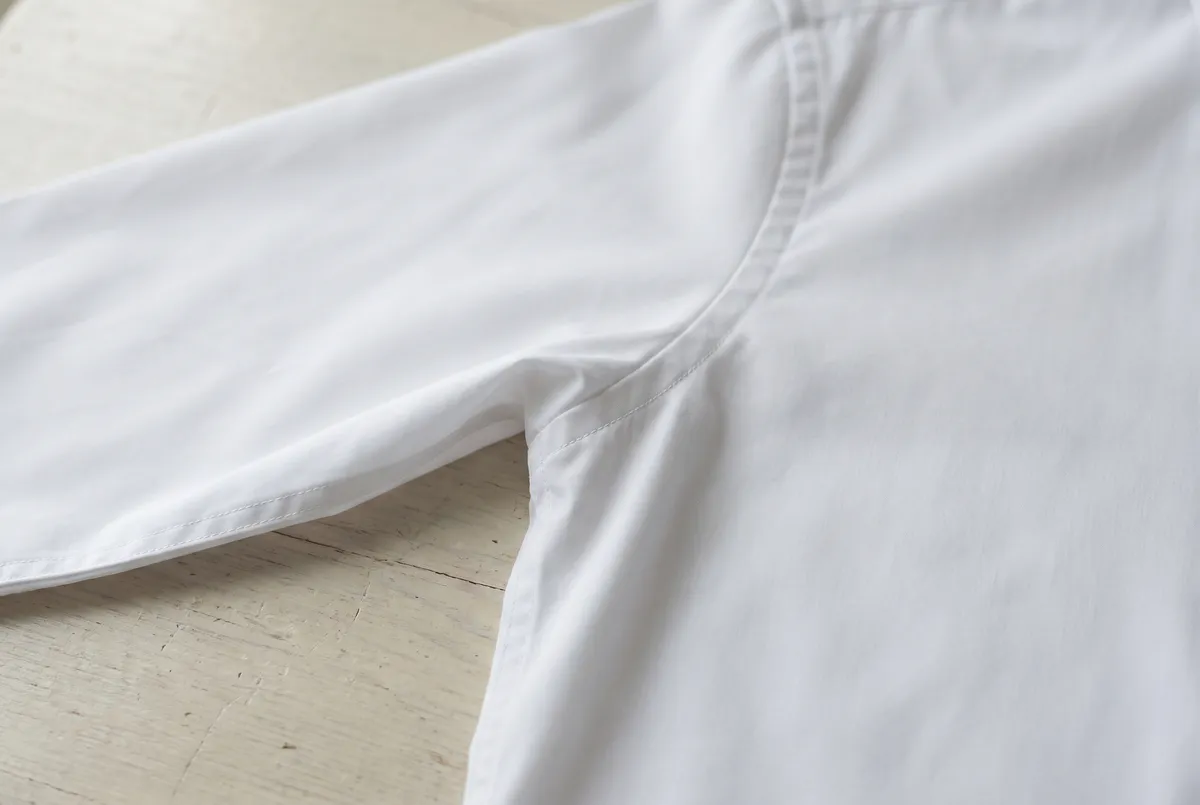
On the shop floor, customers really did come to me about arms that were thick, or thin.
What I looked at first on those occasions was not so much the armhole itself as the curve beneath the arm at its base. On the shop floor this part was called the kama. A sense that the arm is cramped can come from here rather than from the tube of the sleeve.
Where an adjustment made for the figure can reach, the way a shirt feels to wear changes a great deal. Left without that adjustment, a shirt will be pulled somewhere, depending on the figure. The adjustment takes that pull away, and so the balance improves. On a ready-to-wear shirt, though, the kama can hardly be moved at all. A ready-to-wear shirt is built on what the greatest number of bodies have in common, and where a body departs from that, alteration cannot absorb all of it. The kama is one such place. So a shirt that is cramped here comes to a dead end if the problem is worked on inside that shirt. From there on it is no longer a question of the sleeve’s measurements but of how a shirt is to be come by at all. That question sits in the closing sections of The Essence of Dress Shirt Size.
Lengthening Stops at What That Shirt Holds
Lengthening a sleeve was an alteration that really was done. When length is to be moved, the easiest place to work on is the cuff. So whatever difference is left once the other measurements have been fitted drifts over to the length. On the shop floor, too, it was often here that length was adjusted. What is looked at first is the inside of the cuff. Cloth has been folded in there. A sleeve cannot be lengthened beyond what that folded-in cloth allows. So even among shirts that are all “a little short,” there are those that can be lengthened and those that cannot.
Shortening, though, was not something I settled from the figure of one stationary posture alone. I would ask the customer to bend his arm, to reach it out in front of him, and to raise it. In each of those I looked for enough room that the cloth did not strain, and then decided how much to shorten. That is because the arm moves. Within the range it moves through, I was judging how far the sleeve could be shortened. Cloth shrinks as it is washed again and again. A finished measurement changes as the shirt is worn, and as it goes through care time after time. The figure taken on the day of measuring does not necessarily last unchanged. The shop floor I stood on was one where a ready-to-wear shirt could be altered, and where measurements could also be drawn up from scratch. What I set down here, I should make clear, is a way of looking I acquired there.
When judging whether a sleeve could be lengthened, I looked at the shoulder end as well as the cuff. And when a sleeve is shortened to an extreme, wrinkles can appear around the seam where sleeve and cuff are joined. How far shortening may go is a line I do not draw here. I do not have enough to show where it falls.
Moving the Sleeve Generally Leaves the Other Measurements Where They Were
The sleeve is a part in its own right. It is cut separately from the shirt’s body and sewn on to it. On the pattern, it is not linked to the other measurements.
So whether a sleeve is shortened or lengthened, the neck, the chest and the body by and large do not move. Since what is being moved is the length and nothing else, what needs watching is how sleeve and cuff relate to each other, and that alone. The sleeve can be moved without the shirt being made over again. The work itself is not difficult, whether shortening or lengthening. What is difficult, as written above, is whether that shirt still has cloth left.
A jacket is another matter. It has more pieces, and a single place is not enough when fitting its measurements — I wrote about that in The Essence of Suit Size.
In Closing: A Cuff Is Fitted to the Arm and to What Else It Holds
The movement of the hands readily catches another person’s eye. Among the measurements, the cuff sits on the side that is seen.
Its girth is decided by the arm and by what fits in beside it, taken together. The length I decided with allowance for the range the arm moves through. How much longer a sleeve can be made has an upper limit: the cloth left inside the cuff. Either way, there is something besides the arm to look at.
The confidence you wear wins the game.
Frequently Asked Questions
With the arms left to hang naturally, about a centimetre to a centimetre and a half is the mark to go by for how far the shirt cuff shows past the jacket. It is a figure that holds together with the length of the jacket sleeve.
Sometimes they can. Not on every shirt, though. The reason is that how much cloth has been folded in at the cuff sets the upper limit. On the shop floor, the first thing I looked at was the length of that folded-in cloth, and I judged from it whether the alteration could be made.
The girth of the cuffs, on a shirt whose measurements could be drawn up for the customer, I did make different on the left and the right. That is because the girth needed changes with which wrist the watch is worn on, and how thick it is. As for length, many people’s arms differ between left and right, so I asked each customer how far he wanted that taken into account.
Meeting people with them undone is discourteous. It is another matter when the length of the sleeve was decided on the premise of leaving them undone on purpose; then it can sometimes be seen that the shirt was made with that much thought.
The yuki is a measurement taken from a single point on the back to the cuff, and its definition is given in The Essence of Dress Shirt Size. A shop in Britain or the United States gives that same figure as the sleeve length. Where this piece writes of the “length” of a sleeve, it means how long the sleeve itself is, rather than that figure.