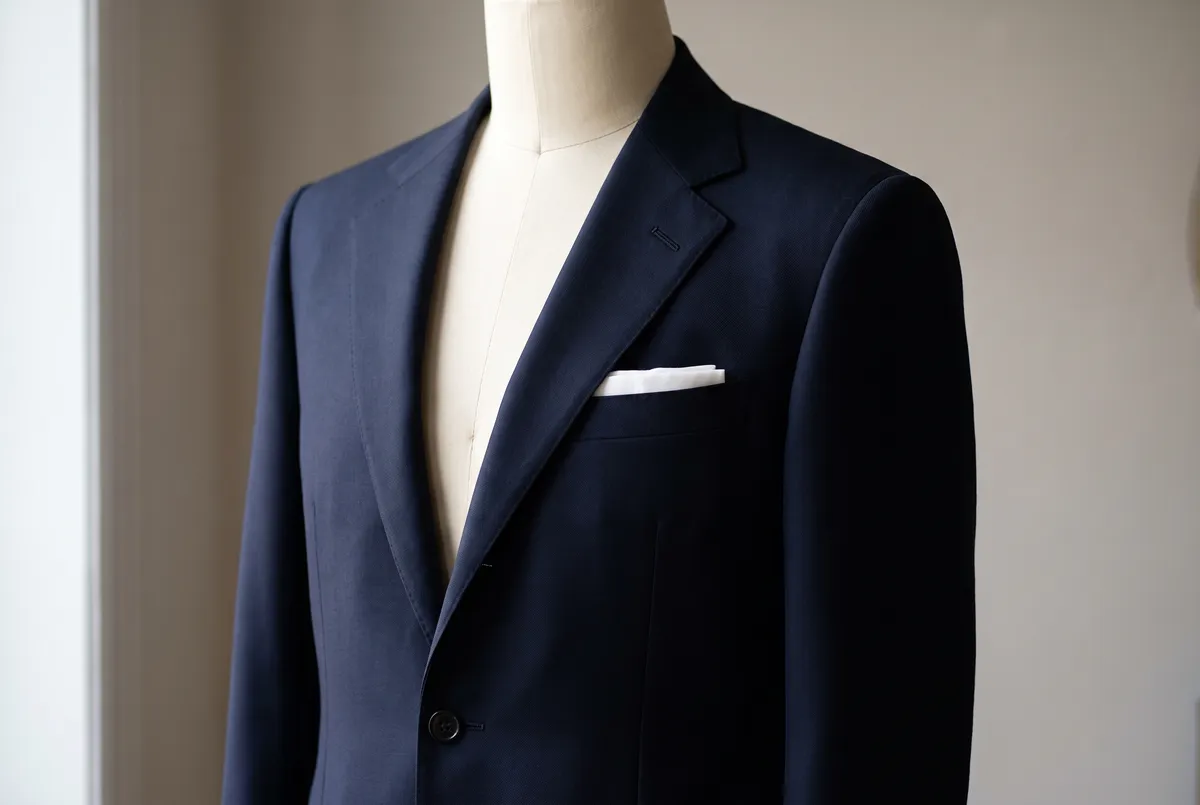
A ready-to-wear suit sold in Japan is sized against a national standard. It is JIS L 4004:2023, Sizing systems for men’s garments, and where the jacket is concerned, what that standard undertakes ends at the measuring of the wearer’s body. Which build of man wears which designation: that much is settled. There is nothing wrong with the label itself.
What actually troubles you in the fitting room, though, is not readable from that designation. Whether the shoulder is sitting where it should. Whether the sleeve runs long. Where the hem stops. The standard sets none of these, and what it does not set never reaches the label.
So what lies between the point where the designation stops and the point where the way a suit sits is decided? I will set it down in the order I used to work through it on the shop floor, one jacket at a time.
I Measured the Chest, and Checked Everything Else Jacket by Jacket
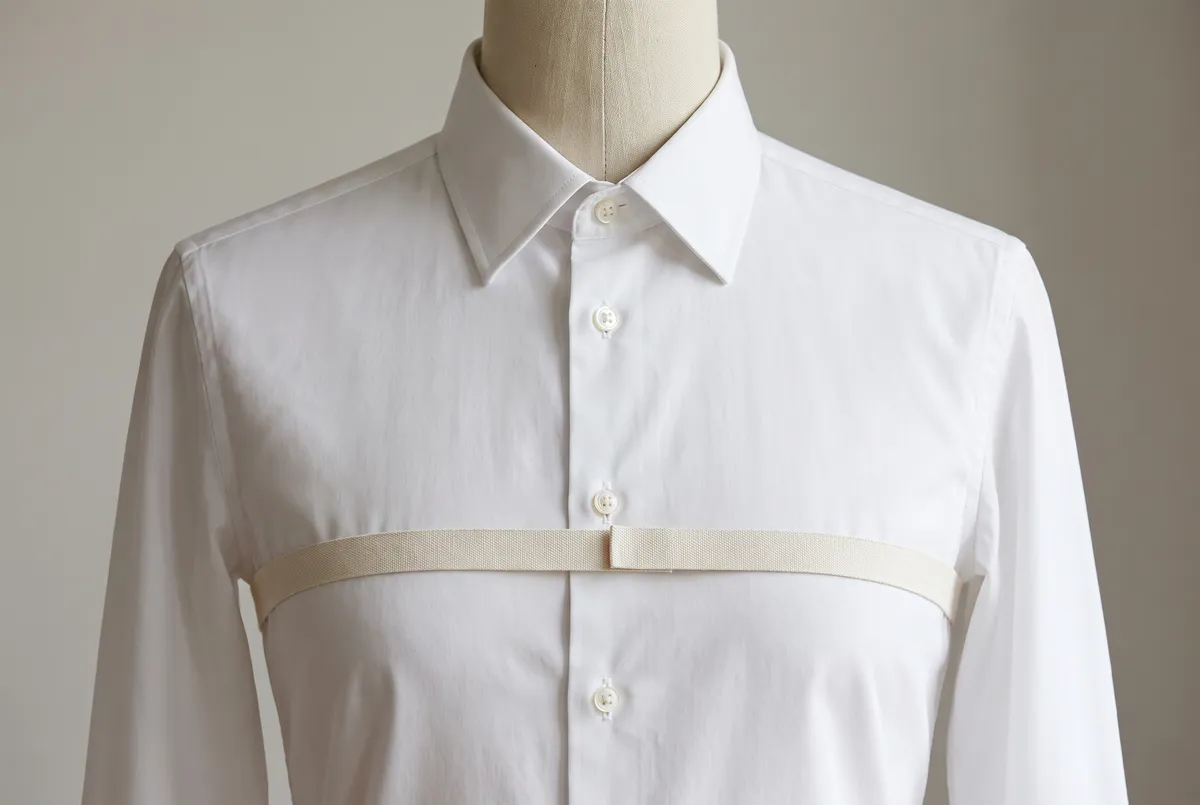
When I settled the size of a jacket, the tape I put on a customer went once around the chest, and that was all. With that figure in hand, the European number follows. Nothing beyond it follows. Shoulder width, sleeve length, the length of the coat, the shaping at the waist — every one of them is fitted afterwards, jacket by jacket.
Why is one measurement not enough? The reason sits in how a suit is built. A jacket is assembled from a great many pieces, and every piece has a pattern of its own. Under the same designation the silhouette changes when the maker changes, and it changes again between two models from a single maker. Add to that the way the work is done, by hand or by machine, and the interlining — the inner structure that builds the shape. Both the feel and the look come out as something else. Fit one measurement, then, and the rest do not come along with it.
A shirt is a different case. With fewer pieces in it, the idea of absorbing an adjustment at a single point still works. That idea cannot be carried across to a jacket, where more than one place has to be fitted from the outset.
The Japanese body-type designation, then, was not the first figure I looked at. Let me say plainly where this way of working comes from. It comes from a shop that carried ready-to-wear built to be altered and, alongside it, took a great many commissions to measure. The European numbers run on a system separate from the Japanese standard, and the six that shop actually carried were 42, 44, 46, 48, 50 and 52.
What the Standard Settles for a Jacket Is the Body Inside It
What JIS L 4004:2023 lays down as the size of a ready-to-wear garment is, in truth, not much. Three of what the standard’s own English text calls control dimensions: chest, waist and height. One specific garment measurement — the inseam, or inside leg length, of the trousers. That is the whole of it. The first three are figures taken on the body of the man who will wear the garment, not finished measurements of a jacket. Only the fourth is of another character, being taken on the trousers themselves once they are made. What a jacket carries is the first three.
A designation such as 94A5, which is how the standard’s tables read, is those three gathered into one string. The number in front is the chest; the letter in the middle is the body type; the figure at the end is the height class. Body types are separated by the difference between chest and waist. There are ten of them: an A build carries a difference of 12 centimetres, AB 10, B 8. The smaller the difference, the thicker the trunk against the chest. That too is a gap between two measurements taken on the body, and not a statement about the jacket. Read the string as what it is: a designation from a Japanese standard.
The standard’s undertaking ends there. Shoulder width, the length of the coat, sleeve length, the width through the body, the rise — the measurements that actually build the way a suit sits are outside its sizing system. They are not forbidden. A table of finished measurements, where a shop supplies one, sits apart from the standard’s size designation, and is supplied at the maker’s own discretion. Since the standard sets no figures for them, they do not agree from one maker to the next. That is not a defect; it is how the arrangement was built.
Within the same national series, the shirt faces the other way. JIS L 4107 covers dress shirts in an annex of its own, and there the size is set as a garment measurement — a measurement taken on the finished article. Both figures on a shirt label, the neck and the yuki — neck and sleeve length — describe the shirt, not the man in it. The Essence of Dress Shirt Size was written on that premise. A jacket runs the opposite way, its designation sitting on the side of the body. Two standards from one national series, and the thing being measured points in opposite directions. Read them side by side and this is the point not to confuse.
So a question like “how many centimetres is the shoulder on an AB6?” has no single answer. The standard does not decide it. That the figures fit your body, and that the suit sits well on you, are two different things.
Cloth Pulling While You Stand Still Means the Measurement Is Short
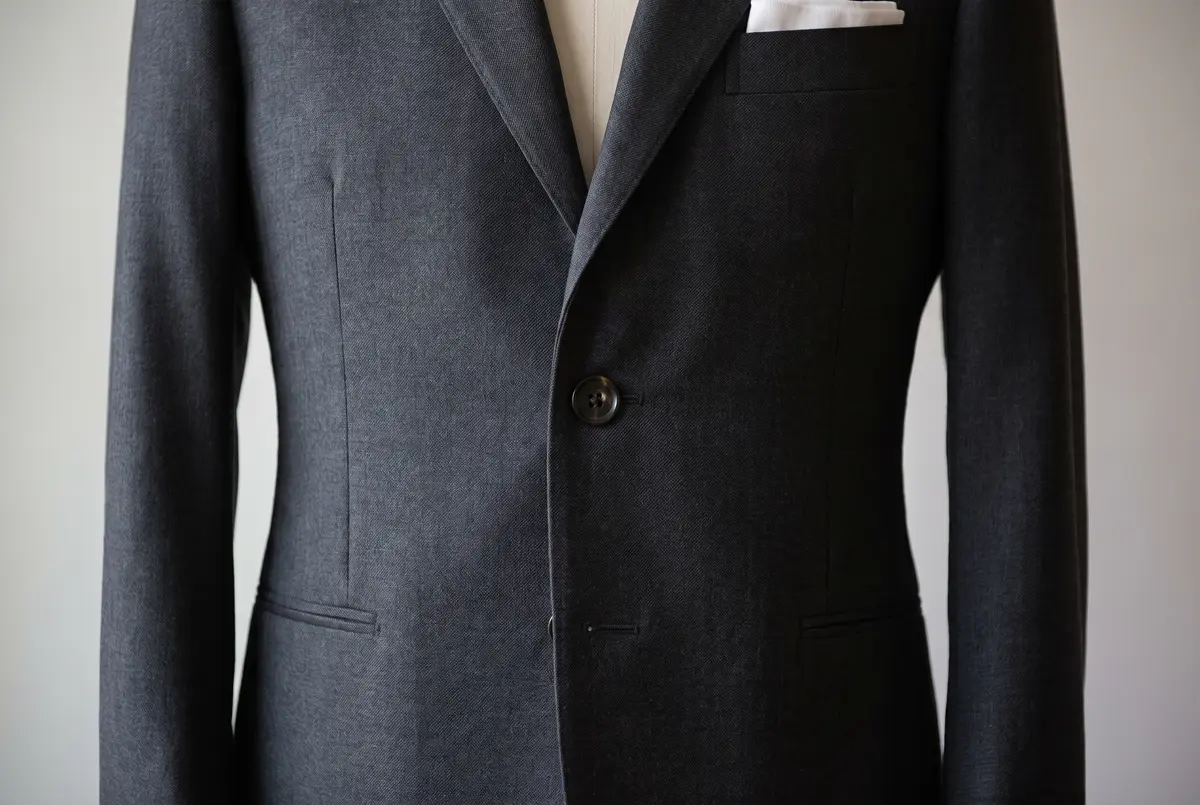
What the label can tell you ends here. Past this point there is nothing to go on but the sight of the suit on the body. The Essence of the Suit deals with what a suit carries for the man wearing it; what is at issue here is one thing only — whether this particular jacket fits the body standing in front of it.
The line I drew was at what the cloth was doing. Wrinkling of the sort that movement produces, I let pass and took the order. Where the cloth was drawn taut with the body not moving at all, I changed the size I was recommending. A customer might ask for something closer, or for something with more room; if that line had been crossed, I brought out a different size.
Why does the division hold? Because a suit is measured with the body standing. A pull showing while you stand still means the cloth is short in the very posture it was measured in, and that is a shortfall in the measurement itself. A pull appearing when you sit down or move an arm appears only once the body has left that posture, and it is no evidence that anything is short. Ideally, nothing should pull while you stand; almost everything that arrives with sitting falls inside what can be allowed.
A measure of the wearer’s own taste does come into it. Among men who like a jacket close, some want the lines that form an X around the fastened button of a three-button coat. Where a man wanted that line and knew he wanted it, I took the order as it stood. The rule can be taught; the last inch of it stays with taste.
What Decides an Alteration Is Direction, Not Place
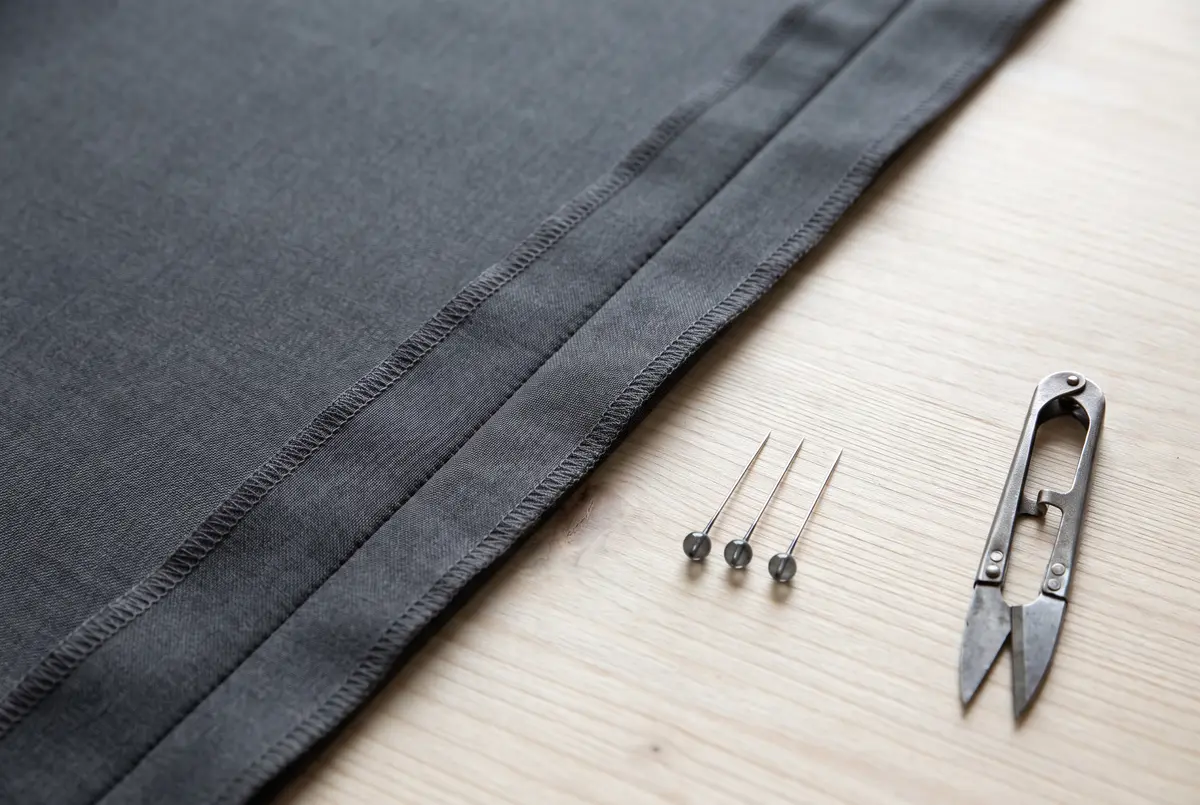
When you come to move a jacket after buying it, only one question really bears. In which direction are you moving it?
As a rule, taking in can be done. Letting out is hard. On a jacket or on trousers, letting out to any great degree is hard wherever you attempt it.
The reason lies in where the cloth is. How much can be let out is decided by how much cloth lies asleep in the seam allowance. Beyond that, the garment holds none. Force it and the allowance grows thin and the seam loses strength. Taking in carries no such constraint, since it only sends the surplus inwards. That is why what can be done is asymmetric by direction rather than by place.
So the thing to establish in the fitting room is not “can this be altered?” but “which way would it be altered?” Do not buy on the assumption that something small will be made larger. Choosing between two jackets, what you want to keep is the surplus that can be taken in.
Knowing the direction does not make everything light work, though. Moving the chest is demanding, and letting out a shoulder is demanding in the same way. Raising or lowering the rise on a pair of trousers belongs to that difficult class as well. Some places stay hard even once you have chosen the easier direction, and it is worth going in expecting that.
Shorten the Sleeve From the Cuff, Not From the Shoulder
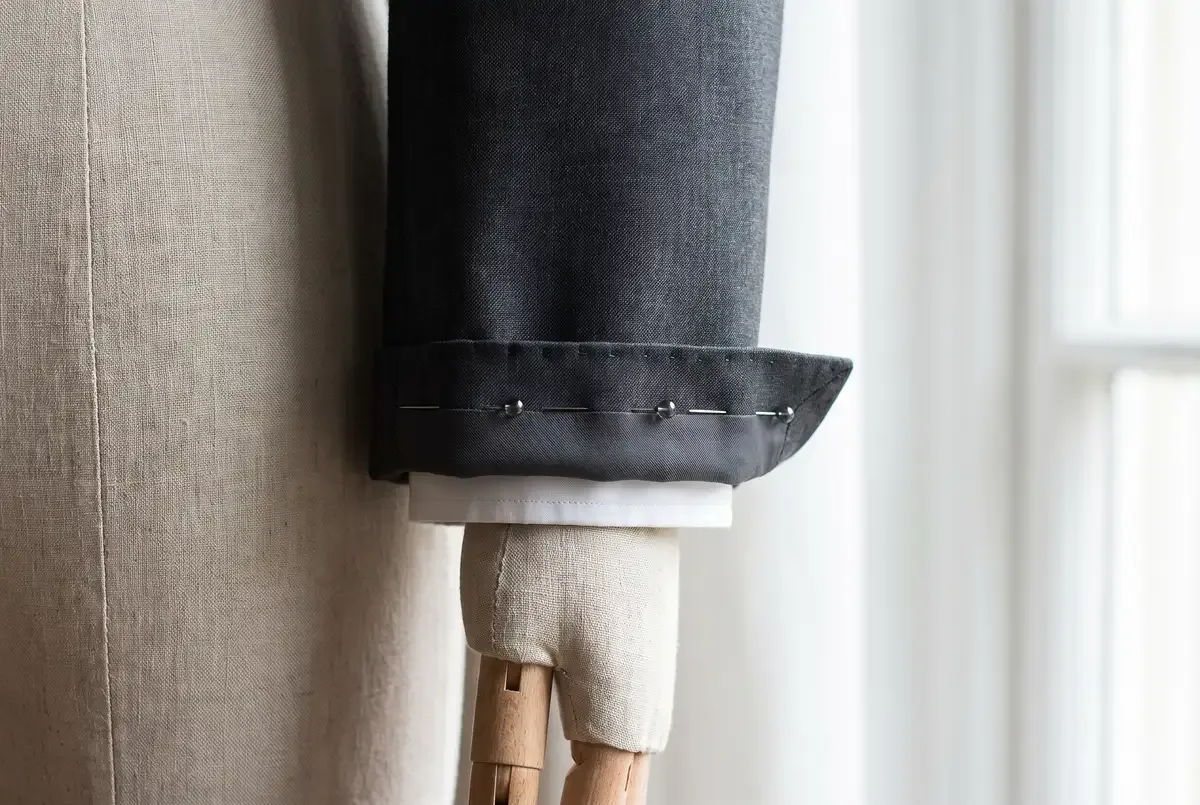
Where, then, does a jacket move easily? Within the balance of the whole, two places move comparatively well: the waist and the sleeve length.
The sleeve comes with an instruction about method. Do not take the length out at the shoulder; take it out at the sleeve. Work from the cuff end and length is all that moves.
The word sleeve covers a different case on a shirt. As The Essence of Dress Shirt Size set out, length is the one thing a shirt sleeve gives up afterwards; how it fits around the arm, and the width at the cuff, are usually settled by having the shirt made, not at the alteration counter. A jacket sleeve can be shortened. The same word, then, but you would do well to treat the range of movement as two separate things.
You Leave Ready-to-Wear Where Two Limits Meet
How far, then, may you go? I do not settle it by counting places. I settle it where two lines meet.
The first comes from the silhouette. Every ready-to-wear jacket I handled had been thought through so that it looked its best in the pattern it was cut to. Each alteration takes it further from that design. With so many pieces, each cut to its own pattern, alteration is possible but it has a ceiling.
The second comes from cost. Every additional place worked on adds to the bill. Small enough one at a time, they stack into a figure you cannot wave away.
Past the point where both begin to bite at once, having a suit made to your own measurements makes better sense than chasing that one jacket, in how it looks and in what it costs alike. I advised shirts on the same reasoning. The asymmetry underneath it, that a garment moves only in the taking-in direction, was taken up first in The Essence of Dress Shirt Size. The boundary is not set by a number of alterations; it is set where the loss of line and the cost overlap.
On the far side of it, the measurements become yours to name. The Essence of the Double-Breasted Suit argued that what is being asked is not the rank a man holds but whether the coat he has his arms in fits him. Measurements can be changed. But the direction in which the jacket you are holding can be moved has an end, and beyond that end you are talking about cutting a pattern.
Made to Your Measurements, and Still Different When You Sit
Naming your own measurements does not guarantee that the finished garment will fit. In my experience the places where a suit made to a customer’s own figures still failed to fit were the waist, the hips and the seat. Tight standing and loose sitting, or the reverse — and the figures exactly as specified.
The main cause is the cloth. A soft cloth with give in it absorbs, up to a point, the movement the body makes when the posture changes. A firm cloth with little give does not. Fit a man standing and only standing, then, and the garment falls short the moment he sits. The same measurements, and what he feels through the day turns on whether the cloth takes the change of posture onto itself.
That is the reason to look at cloth before you look at measurements. The character of cloth, and how to choose it, is the subject of The Essence of Cloth. Season by season, the particulars are in The Essence of Flannel and The Essence of Linen.
One reassurance: on a suit made to your figures, the waist, the hips and the seat can all be adjusted, and where it does not fit, a second adjustment usually brings it back. At the shop where I took orders, the rough guide was about a week for alterations to ready-to-wear and about a month for a commissioned suit to be finished. Shops differ, but if the body shifts during that interval, a further adjustment again answers it.
Look Twice in the Fitting Room, in Two Postures
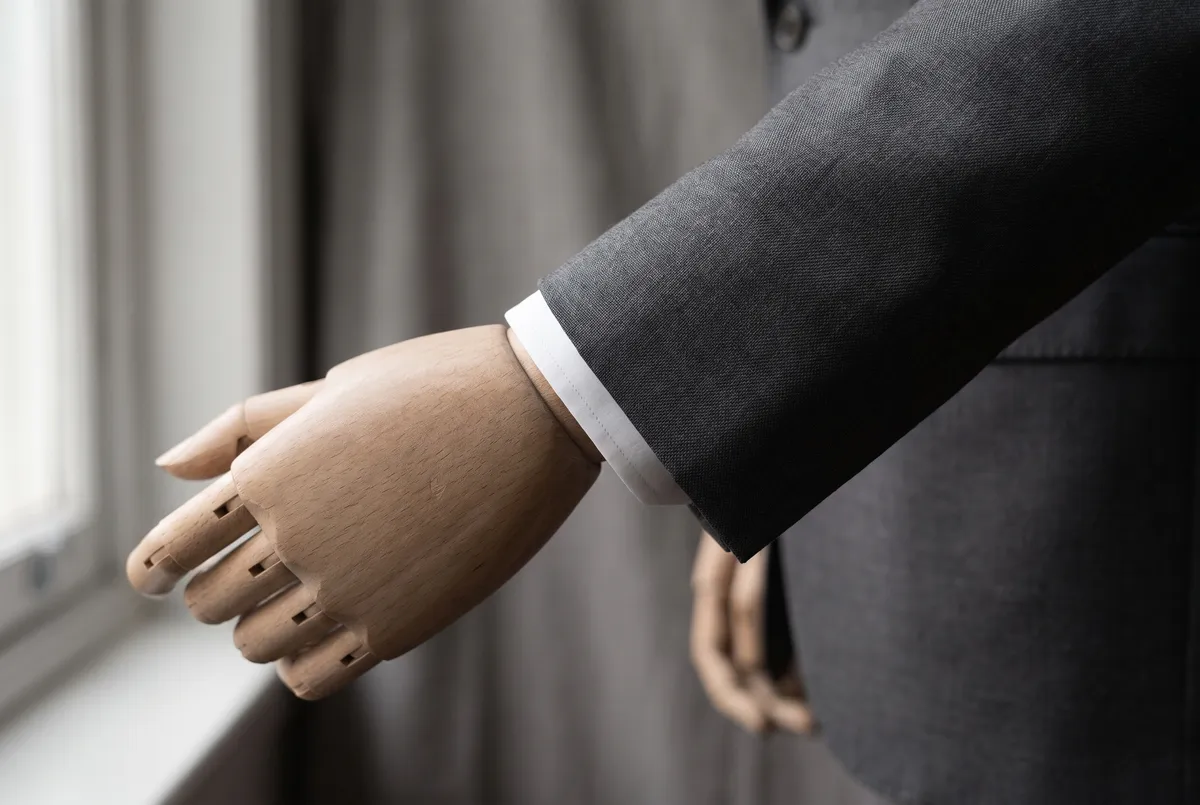
Last, what to do in the fitting room. Having looked at yourself standing, sit down on a chair and put your arms out in front of you.
Sitting with the arms forward changes what you see at the end of the sleeve. If the jacket sleeve is short, the shirt comes out past it — not the cuff alone, but the cloth of the shirt sleeve behind it. The opposite, a jacket from which no shirt shows at all, is out of balance too. Neither declares itself this plainly while you stand with your arms down.
Standing shows the whole figure. And what shows there is not the measurements alone; the posture is showing along with them. Right posture and right measurements do not stand up one without the other. Round the back and the jacket goes out of true however well the measurements fit; get the measurements wrong and straightening up will not put it right.
Why look twice? Standing is the posture the garment was measured in. Sitting is a posture it was not measured in. Look in one alone and you lose whatever happens only in the other. So change the posture, and look a second time.
In Closing: The Label Gives a Starting Point, the Mirror Decides the Rest
The one thing to carry away is a single action. Stand in front of the mirror and go still. Is anything pulling while you hold that? That alone tells you what the label could not.
Stillness says the most because a suit is measured standing. Wrinkles brought on by movement mean only that the body has left that posture; for the most part they are not a shortfall in the measurement.
And the more you alter, the further the garment travels from its design and the higher the bill climbs, both at once. Past the point where the two overlap, stop chasing the jacket in front of you and move across to the side that names the measurements. What the label undertakes reaches as far as the starting point. What decides the rest is the figure standing in the mirror.
The confidence you wear wins the game.
Frequently Asked Questions
In the taking-in direction it can usually be done. The shoulder is like anywhere else in that respect: the hard direction is letting out. How much can be let out is fixed by the cloth left in the seam allowance, and going too far costs the seam its strength. So judge an alteration not by the name of the place but by the direction it moves in. Choosing between two jackets, the safe one is the jacket that only needs taking in.
I do not decide it by counting. The more alterations are piled on, the further the jacket drifts from the silhouette it was built with, and the cost rises alongside. Once both are biting, the reasoning says to stop chasing ready-to-wear and have a suit made to your own measurements, for the sake of the result and of the bill alike. Drawing the line at a number hides the difference between the places that move easily and the places that do not.
Check what changes when the posture changes. Standing still, look for cloth being pulled. Sitting on a chair with the arms forward, look at how much shirt is showing past the jacket cuff. A jacket fits your body only when it passes both.
They are useful for narrowing the rail to begin with. They do not settle the finished garment. The Japanese Industrial Standard JIS L 4004:2023 lays down, as the size of a ready-to-wear garment, the chest, waist and height of the wearer, together with the inside leg length measured on the finished trousers. Shoulder width, the length of the coat, sleeve length and the width through the body sit outside that sizing system. Under one designation, therefore, the finished garment changes with the maker and with the model. Treat a designation that fits your body and a jacket that looks right on you as separate questions.
The main cause is the cloth. A firm cloth with little give does not absorb the change of posture, so a garment fitted only while standing falls short once you sit. Conditions vary from shop to shop, but the waist, the hips and the seat can all be adjusted. Sit down when you collect the suit, and say so on the spot if it is tight. If your body changed while the suit was being made, a further adjustment answers that in the same way.
Source: Japanese Industrial Standard JIS L 4004:2023, Sizing systems for men’s garments — for what the standard lays down as the size of a ready-to-wear garment (control dimensions: chest, waist and height; specific garment measurement: inside leg length), and for the classification of body types by the difference between a wearer’s chest and waist. The three control dimensions are taken on the wearer’s body; the inside leg length alone is taken on the finished garment. / Japanese Industrial Standard JIS L 4107, Annex 1 (dress shirt sizes) — for the fact that a shirt size is stated as a garment measurement, taken on the finished article.