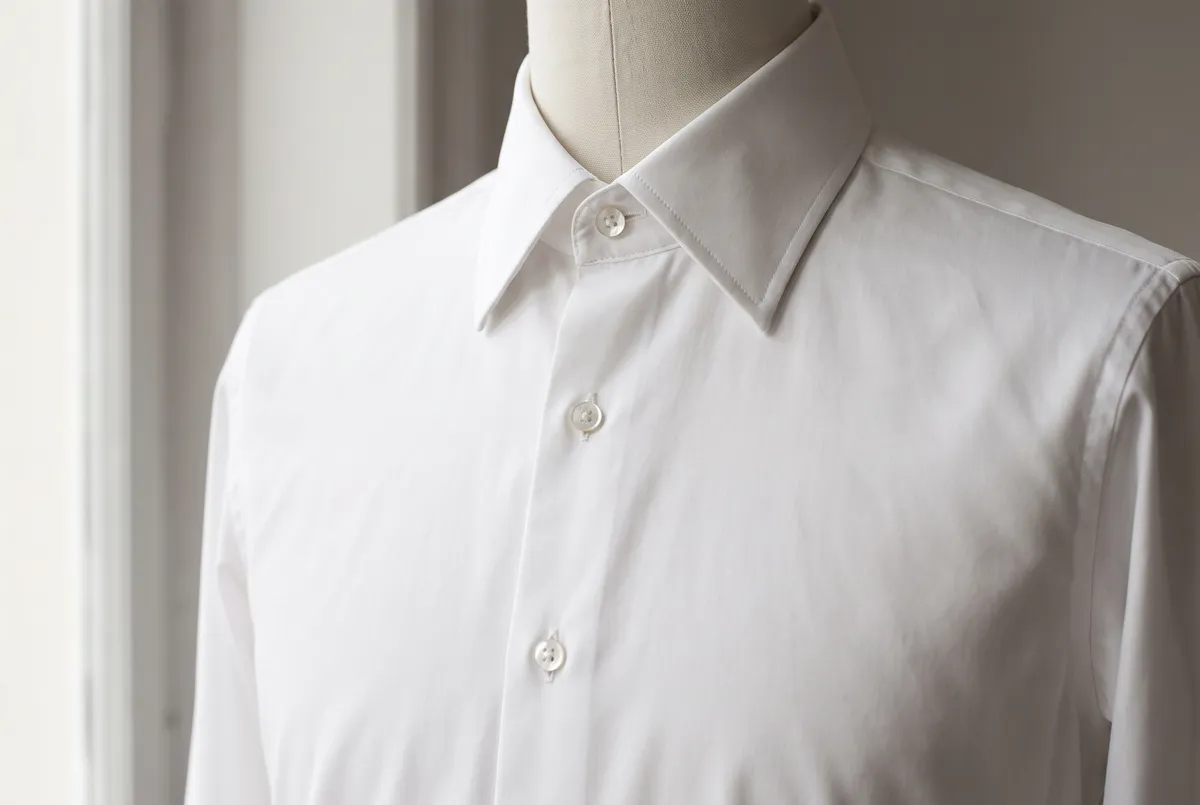
Your neck is not tight. But put your arm forward and the cuff pulls away from the wrist, leaving the watch fully exposed. Or the reverse: the sleeve length is right, and yet the collar nags the moment the tie goes on, so you spend the day with your chin tucked in. Within one shirt, some places fit and others do not — this is not unusual.
Why does one garment differ from itself? Neck, shoulder to wrist, chest, waist. A dress shirt is made of several measurements, and each one differs in how far it can be moved after it has been bought. Measurements you can move, and measurements you cannot. Standing at the rail without knowing that difference is why the order of priority never settles.
The Two Numbers on the Label Are a Pair
On a dress shirt sold in Japan, the collar band or the packaging carries something like “39-82.” Those are two separate measurements, and neither of them is a measurement of you. The 39 in front is the neck, taken along the collar itself; the 82 after it is the yuki — the length from the centre back of the neck, across the point of the shoulder, down to the cuff, which is what a shop in the United States or Britain calls the sleeve length. Both are in centimetres, and both describe the finished shirt rather than the body inside it. The Japanese Industrial Standard JIS L 4107, in the annex that covers dress shirt sizes, sets the size in exactly these two figures.
What deserves attention is the way the standard writes them down. For a single neck size, it gives the sleeve length as a range. In one figure class, a neck of 35 carries sleeve lengths running from 72 through to 86. Neck girth and arm length are not tied together in the standard at all. The standard also carries figure classes, so that the same neck exists in more than one build.
What reaches the rail narrows that range into fixed pairs. 37-80, 39-82, 41-84, 43-86: neck and sleeve climbing together, two centimetres at a step. The interval differs between makers — some move a centimetre at a time, some work in halves — but the pairing itself holds. Choosing from the rail, you are not choosing measurements. You are choosing a combination that has already been decided.
This is worth marking plainly, because it does not hold the same way in every market. In the United States a dress shirt also carries a neck and a sleeve length, and the two are ordered apart: a 16 neck is offered against a 32/33, a 34/35, a 36/37, and the combination is yours to assemble. Britain does the same in a coarser grid, more often by length band than by number. Across much of continental Europe the neck is given alone, with the sleeve left at a single standard length. Japan sits at the furthest point of that spectrum, where the two figures travel together and the pair is the unit of sale. So the particular difficulty described here — that your own combination may not be on the rail at all — is at its sharpest in the Japanese market. The question underneath it, which measurement to fit first, is the same wherever you buy.
And so it happens that your own pair is not there. A narrow neck with long arms. A thick neck with short arms. A combination sitting well inside the range the standard allows, and nowhere in the shop. What fails to fit is not the body. It is what follows from measurements being supplied in pairs.
What follows concerns the working shirt — the one that goes on every morning for the office. Shirts bought for a first interview, and women’s sizing, are decided on different premises, and are left aside here.
Some Measurements Can Be Altered Later, and Some Cannot
From here the question becomes one of order. Which measurement to fit first is decided neither by taste nor by house style. It follows from a fact: whether the thing can be altered.
The neck is best treated as fixed once bought. The collar is made as one piece with the body of the shirt, and it is not something the alteration counter can rebuild. If it does not fit, you and that shirt will not get along.
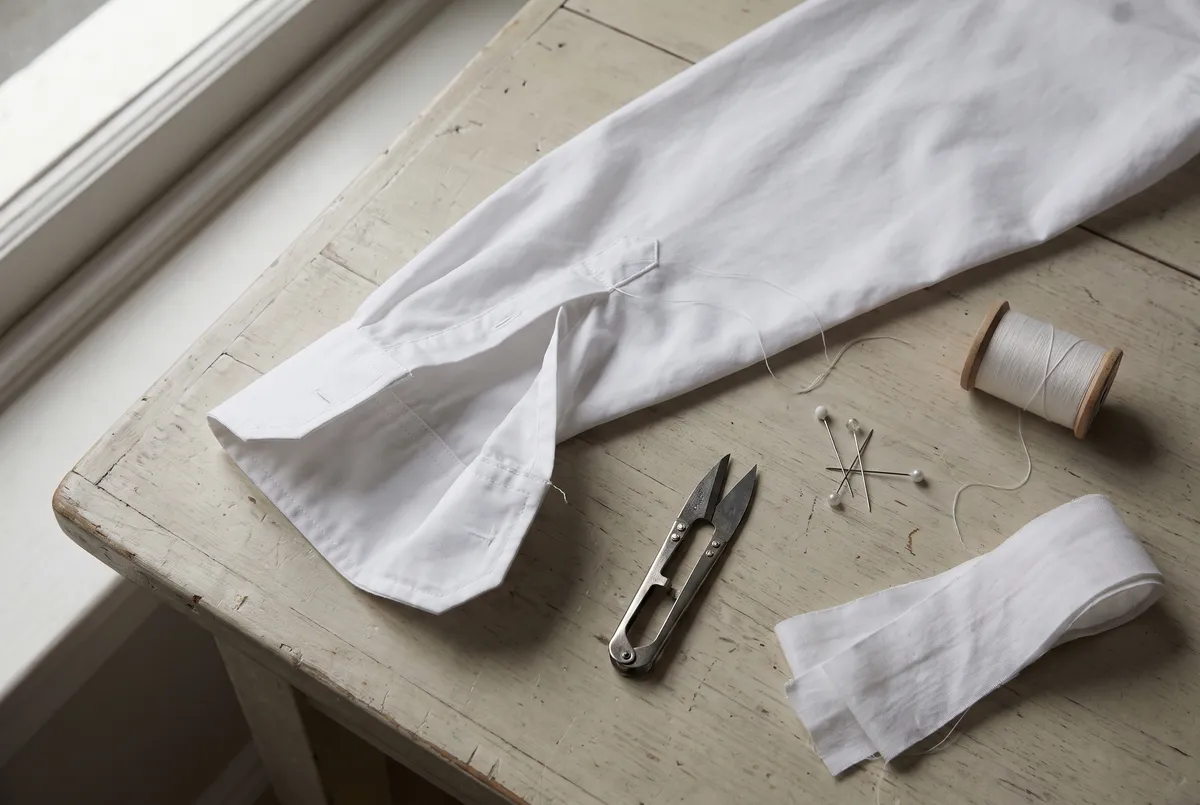
Sleeve length can be altered. Take the cuff off, sew it back, and the sleeve shortens. It moves in one direction alone. With no cloth to draw on, a short sleeve cannot be lengthened.
The body can be altered too, and again in one direction. Excess can be taken in; what is missing cannot be let out.
Set the three side by side and the order settles itself. Fit the neck first, because it cannot be altered. Look next at the body, which moves one way only. Sleeve length, which shortening solves, can wait. That is what it means to fit the measurements you cannot alter.
Sorting what can be put right from what cannot is a test we have applied before: it is how we judge whether a leather shoe has reached the end of its life. Damage that mends, damage that does not. The subject moves from shoes to measurements, but the instrument we judge with does not change.
One note on sequence. The account below starts with the neck and the sleeve, the two that appear on the label. The body, which the label leaves out and which is therefore easy to overlook, is taken up on its own afterwards.
Set the Neck With the Tie Tied
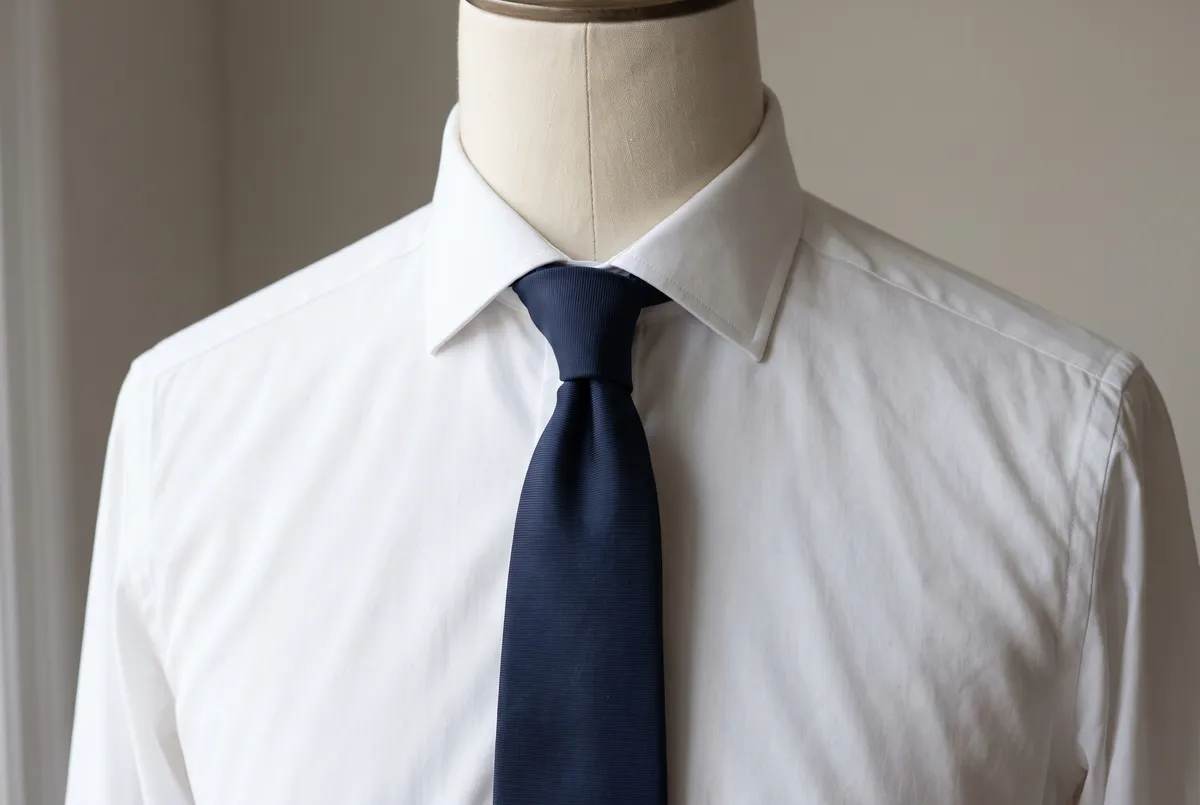
So where should the neck sit? The figure I work to is the measured neck plus about half an inch — one to one and a half centimetres. Fasten the top button and a single finger slides in between neck and collar. Not more, not less.
Shops do not all give the same figure. In Japan the usual advice is to add two to three centimetres to the measured neck, a good centimetre looser than mine; in the United States and Britain it is to add about half an inch, which lands inside my range rather than outside it. On the number of fingers there is no agreement either — some say two, some say one. My reading of why the figures diverge is that they are taken in different states. Mine is taken with the tie tied and the knot settled between the collar points. At the moment it is tied, the collar is drawn in against the neck and the slack has nowhere left to go. That is when you can finally see whether there was too much room.
What does too loose look like? The collar sits directly beneath the face, in the place where another person’s eyes rest longest. The Essence of the Shirt made the case that the collar is the frame of the face, and that case bears directly on neck size. When that frame stands away from the neck, a shadow opens under a knot you had thought was tied. Slack left between neck and collar does not read as room. It reads as a gap in your guard.
Too tight is no better. The neck is the passage for breath and for the voice. Constrict it and one of two habits appears — the chin lifts, or it is drawn in too far. A man who has lost his ease will show it in his face.
A neck size that clings when the tie is tied. Put into words it amounts to no more than that, and tying one on will tell you what words cannot. There is also this: between the size printed on the label and the size of the finished garment, the Japanese standard itself allows a difference. The neck may run from five millimetres under the stated figure to eight millimetres over, and the sleeve length a full ten millimetres either way. Another reason not to settle it on figures alone, but with the tie tied.
On a Sleeve, Only the Length Can Be Altered
Sleeve length is not the length of your arm. It is a measurement that starts from a point on the back, so at the same height it still varies with shoulder width and with posture.
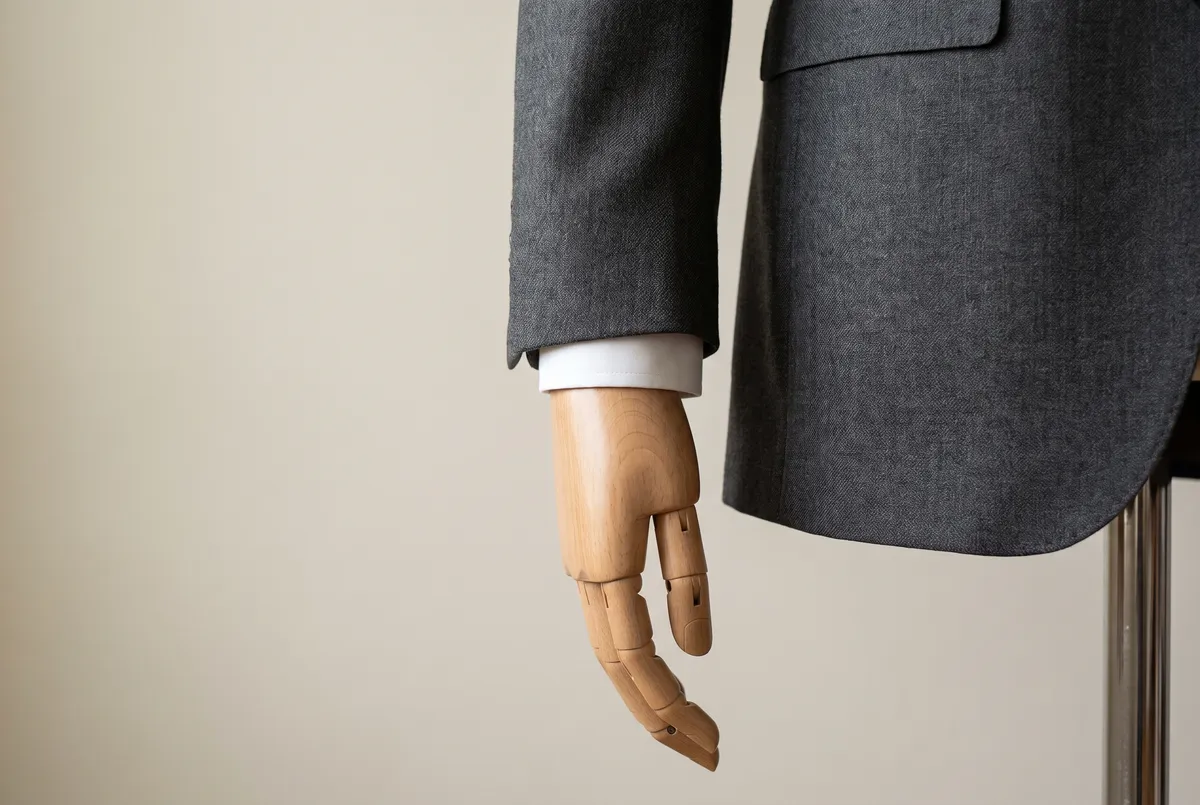
The mark to aim for: with the arms hanging naturally the cuff reaches the wrist bone, and once a jacket goes over it, a centimetre to a centimetre and a half of shirt shows beyond the jacket cuff. If putting your arm forward exposes the wrist completely, it is short. If cloth gathers over the back of the hand, it is long.
The same holds behind. The shirt collar standing above the jacket collar should show by the same amount. When front and back show equally, jacket and shirt stop reading as two garments and become one figure.
As to length, the order set out above applies directly. Caught between two combinations, take the longer sleeve. Length can be taken away; shortness cannot be made good. A shirt whose neck fits and whose sleeve is merely long becomes yours once altered. A shirt whose neck does not fit will never be yours, however perfect the sleeve.
Length, though, is all that can be altered. Sleeve width — the girth around the arm, and at the cuff — is in most cases beyond what an alteration counter can do, and belongs instead to having a shirt made to your own figures. These two are not measurements you correct but measurements you choose, and in ready-to-wear you take whatever width came with the combination.
The sleeve carries an asymmetry, then: its length yields, its width does not. This is where the limits of ready-to-wear show most plainly, and it is often through the sleeve that the state described further on — your combination not being on the rail — first makes itself felt. How to choose the width around the arm and at the cuff is a subject of its own, and is not entered into here.
The Body Needs Fitting Too
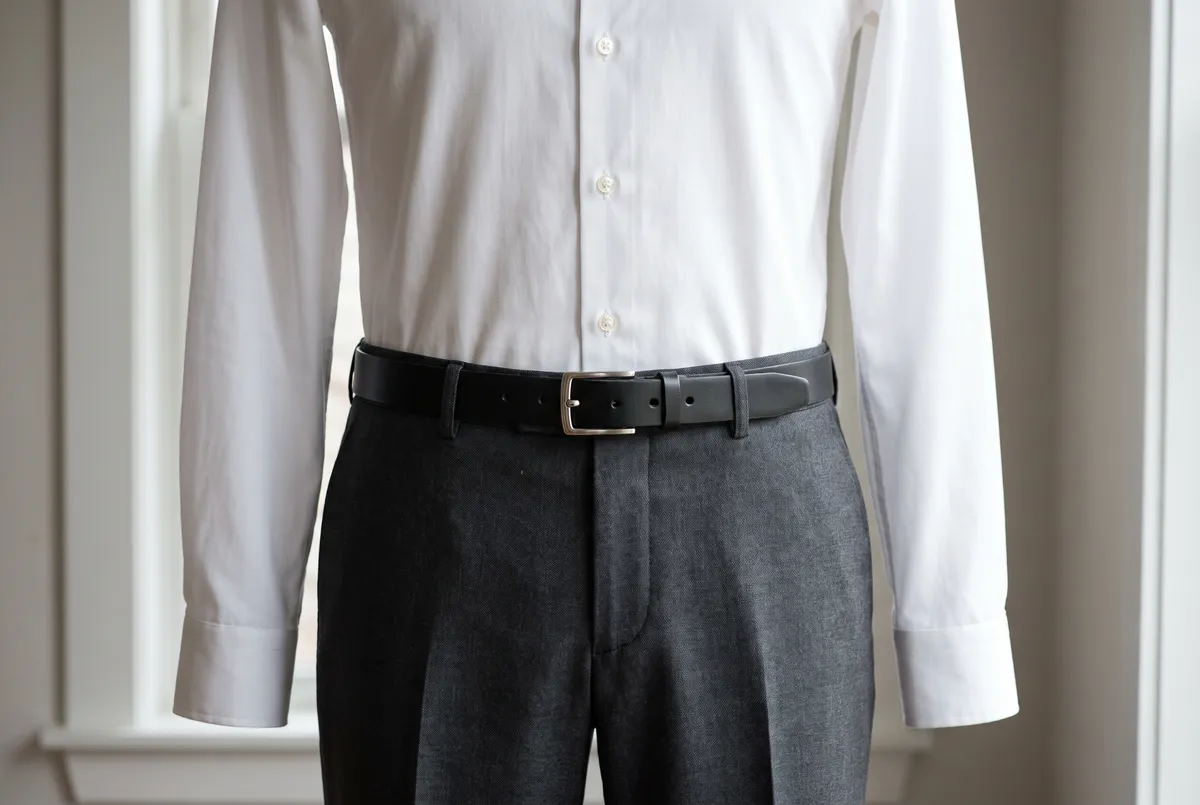
Plenty of men settle the whole question with the neck and the sleeve. Given that the label is made of those two, that is hardly surprising. Yet what spoils the way a shirt sits is usually the chest and the waist.
What I look at first is the shirt tucked into the trousers, and the quantity of cloth left over around the waist. Front and back, left and right, whether that surplus is spread evenly. If it is even, the cloth is not driven to any one point; not driven, it neither folds nor bulges, and a certain amount of surplus never shows in the way the shirt sits. If it has gathered in one place, the measurement is large for the body, or the cut is wrong for it.
The signs of too tight appear at the front. The placket twists. The gap between two buttons opens whenever you sit or move an arm. The signs of too loose appear at the sides and the back. A pouch of cloth forms under the arm, and cloth is left across the back. The cloth creeps up over the belt and the shirt tail works loose. The outline of the body, with the arms down, can look a size larger than it is.
What gets overlooked is that all of this surfaces the instant the jacket comes off. At the desk, and in a meeting held through a screen, the hours without a jacket outnumber the hours with one. Through those hours the garment covering the greatest area of the body is the shirt. Surplus cloth takes a shape somewhere.
So the body, too, is fitted rather than left to the alteration counter. Taking in is possible, but that is work which accepts a surplus; it is not work which creates what is missing. The standard carries figure classes for the same reason: neck girth alone does not settle a body.
Measure in the Middle of the Day
Since the neck cannot be altered, the conditions under which you settle it deserve to be steady as well. In the same body, the neck measures differently in the morning and at night.
In my own fitting practice I have taken early to late afternoon as the mark — roughly between one and four in the afternoon.
The reason, as I read it, lies in the state of the body. The morning comes directly after hours spent lying down. Perhaps because fluid travels evenly through the body then, the neck tends to measure larger at that hour. Spend the hours upright and moving, and fluid settles towards the lower body instead; measure between evening and night and the figure swings the other way.
So I avoid both ends of the day and take the measurement in between. I have no intention of putting a figure on how far it moves. The state of a body differs between one man and another, and between one day and the next. But rather than trusting the first figure of the morning or the last of the evening and buying on it, measuring in between goes wrong by less. That is what long attendance at fittings has left me with.
The point of keeping the conditions steady is that a measurement you cannot alter is being settled on a single reading.
Do Not Buy Big to Allow for Shrinkage
Cotton shrinks in the wash. So should you allow for it and buy a little large? I do not buy that way.
The finished measurement cannot be named at the moment of purchase. Shrinkage varies with the weave and with the character of the yarn, varies again with the make, and varies with how the shirt is washed and dried. Buy against something unreadable and, if it shrinks less than expected, all you are left with is a large shirt. And a shirt a centimetre loose at the neck cannot be altered.
What to do instead. First, buy something that fits at the moment of buying. Then ask the shop about shrinkage: how much it moves after washing, and whether that figure applies to cloth that has already been pre-shrunk. Whether the cloth was shrunk before it was cut changes how it behaves afterwards.
Last, wash one and see for yourself. What the shop can confirm for you is the fact of whether the cloth was pre-shrunk; how far your own shirt actually moves is better answered by your own machine. With the same maker and the same model, the second shirt can be chosen against a figure you measured yourself.
When the Combination Does Not Exist: Search, or Have It Made
Even having followed that order, the combination you need may not be on the rail. It is not confined to the neck-and-arm combinations mentioned at the outset. A slim waist under a full chest. A thick arm, the length right but the sleeve tight. Each sits inside the range the standard envisages, and none of them is in the shop.
There are two roads.
One is to look for a maker whose intervals are different. How the fixed pairs are built varies from maker to maker. Some move in two-centimetre steps, some in one, and they do not hold their figure classes alike. A combination missing from one maker’s rail may be sitting on another’s. Trying enough of them on is worth the trouble.
The other is to have a shirt made to stated measurements. Neck, sleeve length, body, and the width of the sleeve as well — each settled on your own figures. As noted where the sleeve was discussed, sleeve width is the measurement an alteration counter can do least with. If you know that is where your own trouble lies, the road of searching narrows.
Which to take is best decided by how many shirts you wear and how often. The axis is not money but time. At one or two a year, there is pleasure in searching patiently and finding. For a man wearing a shirt every day, who needs several more in rotation, the time that searching costs runs out first. Rather than spending free days at the rail and missing every time, it is quicker to settle your own measurements once.
And once they are settled, they keep. When the body changes, measure again.
In Closing: Fit What Cannot Be Altered First, and the Shirt Follows the Body
A shirt has measurements that can be altered and measurements that cannot. The neck cannot, so it is fitted first: with the tie tied, at the point where it clings. The body moves one way only, so tuck the shirt in and look at how the surplus is spread. Sleeve length can be shortened, so it comes last; caught between two, take the longer. Measure between early and late afternoon. Do not allow for shrinkage in advance — confirm it yourself after buying. And if your combination is still nowhere, search or have it made, deciding by how many shirts you wear and how often.
The two figures on the label are not a summary of your body. They are a combination a maker picked out of a permitted range in order to put shirts on a rail. Knowing that much, you need not doubt your own body when a shirt fails to fit.
A shirt goes quiet once it follows the body. The neck stops asking for attention, the cuff holds its place as the arm moves, and the shape holds when the jacket comes off. When it stops making any claim at all, it has finally become an instrument of work.
The confidence you wear wins the game.
Frequently Asked Questions
The first number is the neck and the second is the yuki, the sleeve length taken from the centre of the back collar, across the point of the shoulder, to the cuff. Both are in centimetres. Ready-to-wear shirts in Japan are sold in fixed combinations of these two, so the label is read as a pair rather than as one number at a time. In the United States and Britain the same two measurements are given in inches and ordered separately, which is why a Japanese label looks unfamiliar at first.
Put the neck first. A neck cannot be altered after purchase, whereas sleeve length can be shortened by taking off the cuff and sewing it back. Caught between two combinations, take the one with the longer sleeve and have it shortened.
Because ready-to-wear shirts are sold in fixed combinations of the two measurements. The Japanese Industrial Standard JIS L 4107, in its annex on dress shirt sizes, gives a range of sleeve lengths against a single neck size, but what reaches the rail narrows that range into set pairs. A narrow neck with long arms, or a thick neck with short arms, may have no pair prepared for it. What fails to fit is not your body; it is that your measurements are absent from the combinations on offer. From there you can look for a maker whose intervals differ, or have a shirt made to stated measurements.
In my own fitting practice I have taken early to late afternoon as the mark — roughly between one and four in the afternoon. I find the neck measures larger in the morning, directly after hours spent lying down, and swings the other way between evening and night. Avoiding both ends of the day and measuring in between goes wrong by less, which is what long attendance at fittings has left me with. How far it moves differs between one man and another and between one day and the next, so I put no figure on it.
I would not. Shrinkage varies with the cloth, the make and the way a shirt is washed, so the finished measurement cannot be named at the moment of purchase. Buy something that fits when you buy it, ask the shop how much it moves after washing and whether that figure applies to cloth already pre-shrunk, then wash one and see for yourself.
Source: Japanese Industrial Standard JIS L 4107, Annex 1 (dress shirt sizes) — for the use of neck and sleeve length as the size designation, the figure classes, and the tolerances allowed on finished measurements.