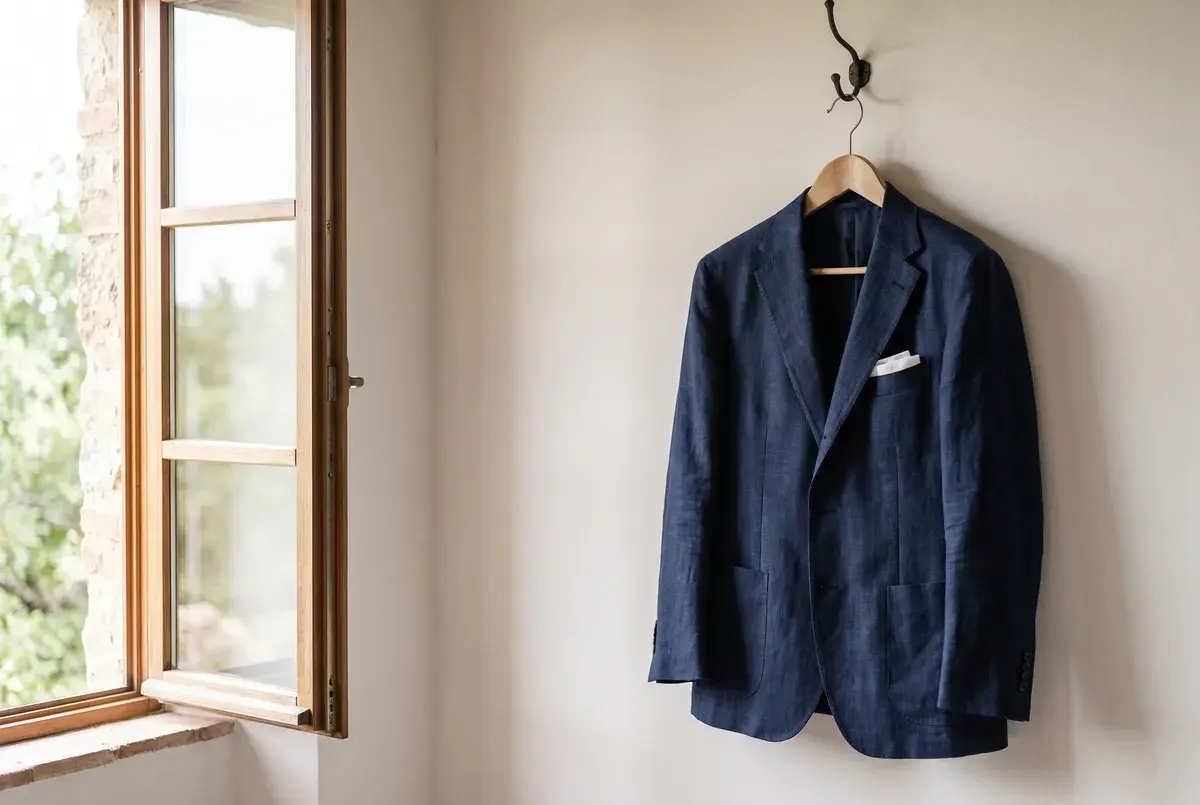
You know the sight: your own reflection in a shop window on the way back from a summer meeting. The shirt is stuck to your back, the knees have gone, the collar has wilted. The suit that was immaculate at eight in the morning has become something else entirely by two in the afternoon.
Let me put it plainly: linen is a real answer to summer, but nothing will stop it creasing. What you get to choose is how the creases appear, and that is decided by the weight of the cloth. And one more thing — if the room you work in is a conservative one, pure linen is not where you begin.
Over many years advising businesspeople of every level — from owners and executives to those just starting out — I have watched a good many men lose ground in summer. The cause is rarely the heat itself. It is what they do about the heat. This article is written to settle that one point. The broader way of reading cloth is set out in The Essence of Cloth, and the two are meant to be read together.
Summer Is When Disorder Shows
As I set out in The Essence of Flannel, winter is the season in which the quality of cloth registers as standing. Thickness produces drape; a dense surface takes light in and returns it quietly; a man in good cloth reads, at a distance, as though he carries his own warmth.
Summer inverts this. The difference registers not as standing but as disorder.
The reason is straightforward. Summer cloth is thin, it sits close to the body, and it is exposed to perspiration. Thin cloth carrying moisture clings, and the outline is lost. Sit for long enough and the knees go; fold your arms and the crease stays in the elbow. The small collapses that thickness absorbs in winter all surface in summer.
Which makes summer the harder season in which to stand out. The winter arrangement — where the man in good cloth quietly distinguishes himself — does not hold. What summer rewards is not the man who stands out but the man who has not come undone.
Only with that premise in place can the question of linen be answered properly.
What Actually Makes Linen Cool
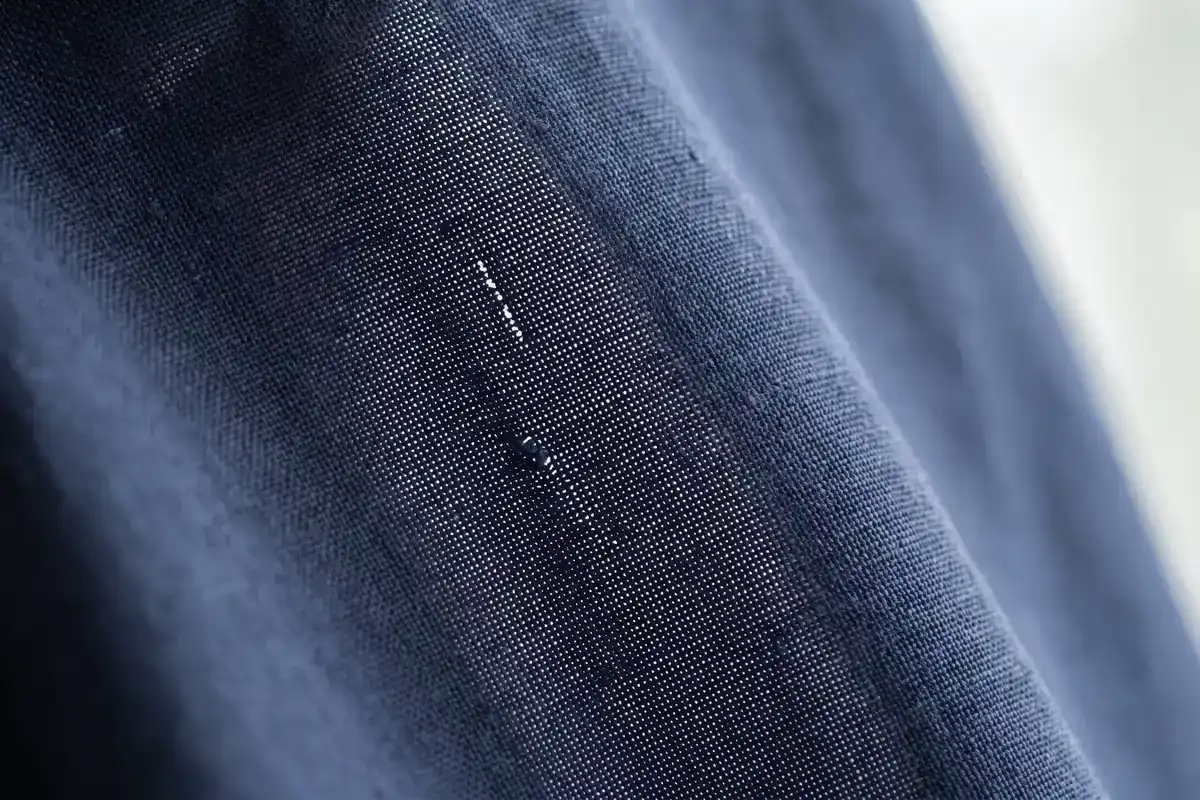
Linen is spun from the stem of the flax plant. It is among the oldest fibres humanity has used, and today it is grown mainly across northern France, Belgium, eastern Europe and China.
Its coolness is best understood as two separate things.
The first is the coolness you feel on contact. Linen fibre conducts heat well, so warmth leaves the skin quickly and the cloth reads as cold to the touch. Permanent Style, Simon Crompton’s British menswear publication, explains it in “The Guide to Linen” (2018) by the same principle that makes metal feel cold. Noticeably cooler than wool, a little cooler than cotton — an order that matches experience.
The second is air moving through it. And here is where the misunderstanding sits. Breathability belongs to the weave, not to the fibre — a distinction Permanent Style draws plainly, and one worth holding on to. The mechanism is simply this: a fibre strong enough to hold a cloth together at a loose setting removes the need to pack the yarns tight, and what is not packed tight lets air through. Openness is the variable. Thinness is not.
To this, add that linen takes up moisture readily and releases it just as readily. It is why the cloth does not cling the instant you begin to perspire.
Linen’s coolness, in other words, is built on two floors: a fibre that sheds heat, and a weave that admits air. Thinness is not what is doing the work. That distinction earns its keep later.
Linen and Ramie Are Not the Same Cloth
Both linen and ramie are bast fibres, both are sold under the broad heading of “linen” or its local equivalents, and in many markets a label will not tell you which one you are holding. In Japan, for instance, the household goods labelling rules allow the single character asa — a catch-all for plant bast fibres — only for flax and for ramie; since the revision of 1 April 2017 the words “linen” and “ramie” may be shown as well. Hemp and jute, despite carrying that same character in their Japanese names, are labelled separately and may not be called asa at all. Which means a garment marked only asa tells you nothing about which of the two it actually is.
The two wear quite differently. Japan’s Boken Quality Evaluation Institute describes ramie as having the crispest hand of any natural fibre, stiff and springy, and so it does not cling to damp skin; its characteristic drawback is that the fibre is coarse and hard enough to prickle. Flax — linen — has high tensile strength and grows stronger when wet, but takes a crease readily.
Neither is superior. For a shirt against the skin the difference is decisive; for a jacket or a suit worn over one, it narrows considerably. What matters is knowing that one word can stand for two different fibres. If the label says linen, it is flax. If it does not, ask in the shop. Becoming the kind of customer who asks is itself worth something.
Creases Cannot Be Removed. They Can Be Chosen
This is the part of the article that matters most.
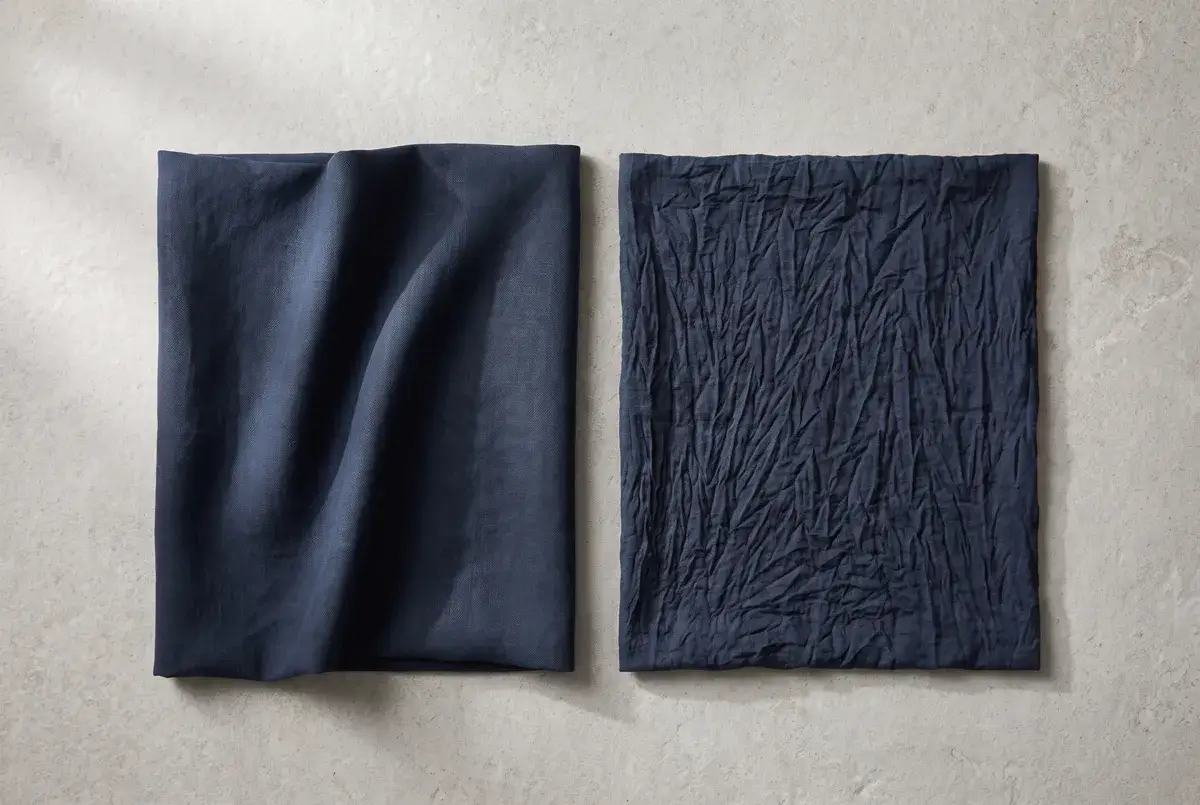
Ask anyone why they avoid a linen suit and the answer is the creasing. And unfortunately, nothing takes the creasing out. The cause is structural: linen has none of the natural stretch that wool has. A fibre that does not extend and recover cannot spring back, so where it folds, it stays folded. Finishing and blending can reduce it. Nothing eliminates it.
So the question has to change. Not whether creases can be removed, but how they appear.
What governs their appearance is weight. Pure linen suitings fall, in practice, into two bands. Permanent Style sets them out as the 10–13oz cloths woven by the Irish mills and the 8–9oz cloths woven on the Continent. The first uses thicker yarn set closer in the loom; the second is spun finer and finished lighter.
And the creasing runs in opposite directions.
Heavy Irish linen creases large and few. The cloth has body, so when it folds it folds across a broad plane. At any distance it reads as shadow rather than as neglect, and the outline stays sharp.
Light linen creases fine and everywhere. Every movement leaves a small ripple across the surface, and from across a room the impression edges towards dishevelled. The lighter cloth looks cooler on the hanger and wears more untidily. In what I have seen, this is the point most often taken the wrong way round.
One point in linen’s favour deserves stating. Because the fibre is long, the cloth keeps its drape even once creased, and it does not bag at the knee. Permanent Style goes as far as to say that after four or five wearings a linen suit may look better than some wools. Creasing is real. It is not the same thing as losing shape.
Choose light out of fear of creasing and you will look more crumpled, not less. Choose heavy and the creases become shadow. That is the heart of choosing linen.
Why a Heavy Linen Still Works in Summer
Set those weights beside ordinary suiting.
As shown in The Essence of Cloth, cloth weight is generally expressed in grams per linear metre at 150cm width, and the usual guide for spring and summer is roughly 200–250g. It is tempting to convert Irish linen at 12–13oz into grams, but the conversion depends on how width and length are measured, and the trade itself is not consistent about it. So let us not stack the two. Ounces against ounces will do. The staple flannel of Fox Brothers, cited in The Essence of Flannel, is 14–15oz. An Irish linen meant for summer sits close to the weight of a winter cloth.
A contradiction? No.
A heavy linen simply uses thicker yarn. It is not a closed cloth. If anything, thick yarn woven open is precisely what produces a substantial cloth that still breathes. The intuition that light means cool does not hold here.
The same logic explains fresco, the high-twist wool that has long been a summer staple. Its coolness comes from an open weave of tightly twisted yarn, not from being thin.
So when you assess a summer cloth, the number to check is not the weight. Hold it up to the light and see whether the weave is open. Anyone can do that in a shop.
How Far Can You Take It in a Conservative Office
Now to the question that actually troubles people.
In Japan, summer dress opened up decisively in 2005, when the Ministry of the Environment paired a call for lighter office clothing with a recommended cooling setpoint of 28°C. Two decades on, few workplaces object to a man removing his jacket in high summer.
But a pure linen suit is not at the centre of that freedom, and I will say so plainly. Where dress is expected to be conservative — finance, law, dealings with government — I would not make a full suit in pure linen your working staple. Permanent Style is equally direct: navy linen works, but not as the formal suit, not as a replacement for worsted at the office.
That is not a reason to give it up. There are stages.
The first is a wool-linen cloth. The wool’s recovery holds the creasing down while the linen brings the air and the coolness. It reads much like a wool suit and wears like a summer one. If you have to get through summer in a conservative room, this is the surest answer available. Wool with silk and linen does the same job.
The second is linen in the jacket alone. It reads far lighter than a full suit and is far more readily accepted. Pair it with trousers in high-twist wool. One caution, on which Permanent Style is firm: do not put a linen jacket with linen trousers in a different colour. The textures sit so close together that the pairing reads as a suit you failed to match rather than as a combination you intended.
The third is the pure linen suit. If you are going there, take the heavy Irish cloth, for the reason set out above. It belongs to dinners outside the office, to business done somewhere warm, to the private end of summer.
The test reduces to one question. Will you be the least formally dressed man in the room? If yes, it is too early. If no, there is no difficulty. How you dress is never settled by you alone; it is settled against the room — the principle set out in The Essence of the Suit.
Begin with Navy and Tobacco
Say linen and most men picture a cream suit. Then they try one, and find it does not suit them. That is hardly surprising. Cream from shoulder to ankle is the hardest thing linen asks of a man.
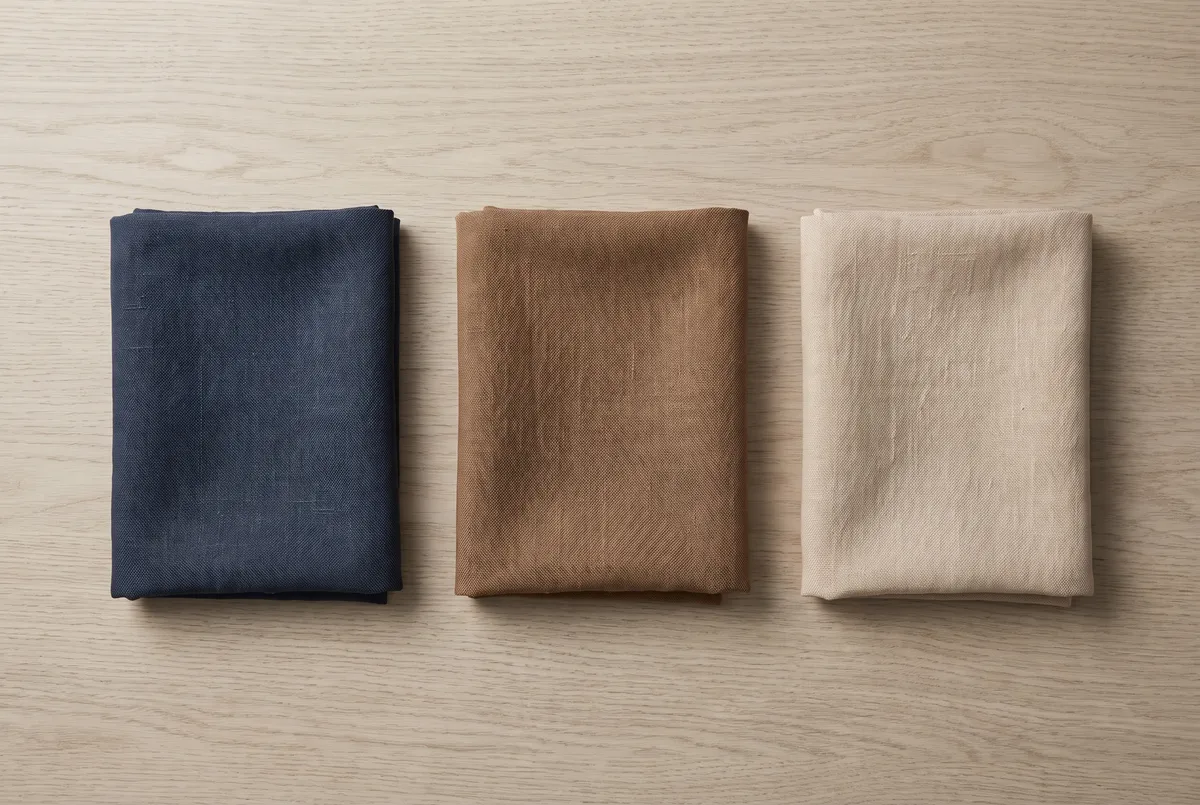
The workable range sits somewhere quieter. Permanent Style names tobacco, olive and dark green, with off-white or biscuit as the better alternatives to cream. All of them sit well against skin, tanned or otherwise. Translated into a business wardrobe, the two to begin with are navy and tobacco.
Navy is the colour in which linen loses none of its seriousness. But as above, it is not a substitute for the navy worsted. It is a second suit, for a different season.
Tobacco is still rarely worn, which is exactly why it works. Brown sits close to skin tone, softens the face, and stands quietly apart in a sea of navy and grey.
Leave the pattern out. Linen already carries texture: the irregular thickness of the yarn shows as slubs across the surface, and that is expression enough. Add a pattern and it becomes too much. Plain will do.
For shoes, leather with a restrained polish is the right partner. Rather than lightening the shoe for the season, a closed-lacing shoe in a settled colour anchors the lightness above it. For the shirt, a good white remains the strongest thing you can wear.
Caring for Linen Is the Reverse of Caring for Wool
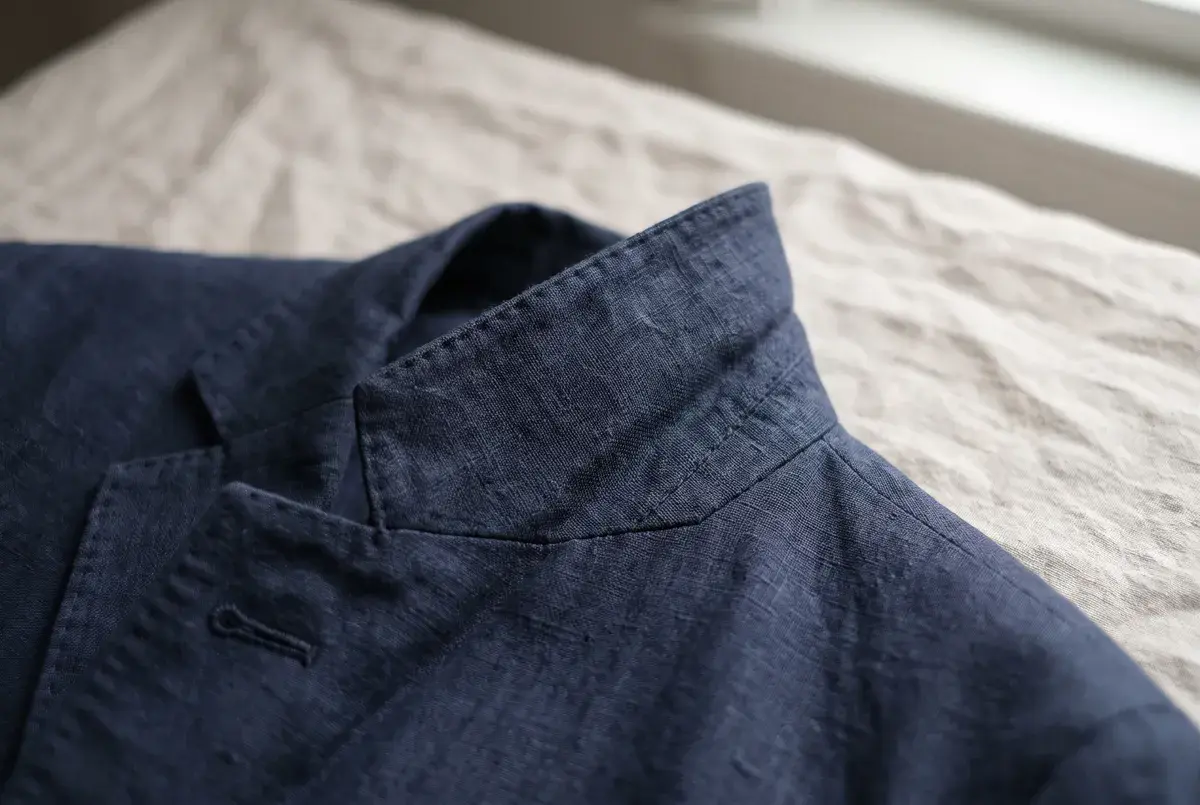
This surprises people: looking after linen runs opposite to looking after wool.
Wool begins with the brush. A raised surface holds dust, dust invites friction, and friction produces pilling. With a cloth like flannel, brushing largely decides how long it lasts.
Linen barely needs it. The surface is smooth and does not fuzz, so there is little for dust to catch on, and a jacket will go several wearings without a brush.
Abrasion is not what finishes it either: elbows and seat will not wear through. What ends a linen garment is the fold. Permanent Style makes the point that linen gives way where the cloth is creased in the same place again and again until the fibres split, the top of the collar being the classic example — which matches what I have seen. The rest of the cloth is still perfectly sound; a single line of wear finishes the garment.
Which leaves three things to do. Do not wear it on consecutive days (true of any cloth); do not store it folded the same way for long periods; and have it pressed once during the season. You are not trying to remove the creases. Resetting where the folds sit is enough.
Washing a jacket or suit at home is not something I would advise. The canvas and the construction are not built to take water. That linen as a fibre is strong when wet, and that a tailored garment is strong when wet, are two different propositions.
If You Buy One, Buy This
Knowledge that does not resolve into a choice is of no use. So, one recommendation.
Plain navy, in wool-linen, at around 250g.
Nothing else covers summer so reliably. It passes in conservative rooms, the creasing stays in hand, and it still reads properly when the jacket comes off. That suit is the staple, and it comes first.
Enjoy linen for its own sake with the second suit. Irish linen at around 12oz, plain, in tobacco. At that point the creases stop being a fault and start working as shadow, and summer acquires a depth no other cloth will give it.
Keep to that order. As set out in The Essence of Cloth, a plain dark navy and a plain charcoal grey in wool come first — the two that carry the working year. The seasonal suits follow. Keep to the order and linen widens what you can do. Ignore it and linen becomes a suit in search of an occasion.
In Closing: Linen Asks You to Accept the Creases
Linen will not make you look immaculate. Wear it and it creases. That is the specification, not the defect.
The order to look in is settled. Understand that the coolness comes from the weave rather than from thinness; establish which fibre the label is describing; choose how it creases by choosing its weight; and in a conservative room begin with wool-linen. Navy and tobacco, no pattern. For care, mind only the folds.
Some men lose ground in summer; others never come undone. What separates them is neither constitution nor endurance, but knowing what to ask of a cloth. The man who fights the creases is worn down by them. The man who accepts them stays cool.
The confidence you wear wins the game.
Frequently Asked Questions
The quality of its coolness differs from other materials. Linen fibre conducts heat well, so the cloth feels cold the moment it touches the skin, and because the fibre is thick and strong it can be woven open, which lets air pass through. It also takes up perspiration readily and releases it just as readily, so it does not cling the instant you begin to sweat.
It does. Linen has none of the natural stretch that wool has, so there is no method by which the creasing can be removed. How it appears, however, can be chosen. Heavy Irish linen creases large and few, reading as shadow, while light linen creases fine and everywhere. If you want it to look crisp, choose the heavier cloth.
It depends on use, but abrasion is not what ends it. Linen is strong, and elbows and seat will not wear through. It fails where the cloth is creased in the same place repeatedly and the fibres crack, classically along the top of the collar. Avoiding consecutive wearings and not storing it folded the same way for long periods matters most.
They are different bast fibres. Linen is spun from flax; ramie comes from a different plant and has the crispest hand of any natural fibre, stiff and springy, but coarse enough to prickle against the skin. In some markets, including Japan, a label may cover both under one word, so it is worth checking whether it specifically says linen.
It depends on the wedding. For a daytime garden or destination ceremony where the invitation calls for informal dress, it is a reasonable option. For a formal ceremony, or when attending as family, it is not. Linen carries creases and slubs on its surface and so reads more casually than a worsted. When in doubt, leave it.