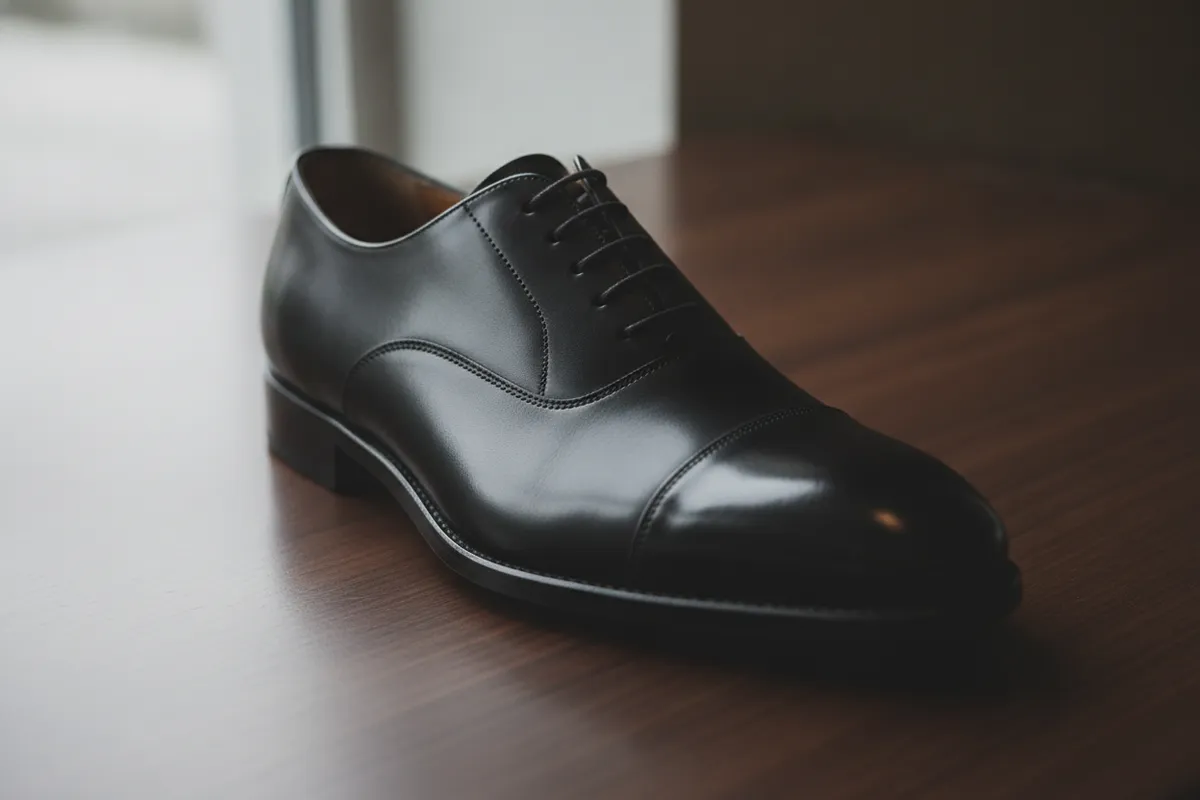
Of everything a man wears, only his shoes sit farthest from the other person’s line of sight. Which is exactly why cutting corners there carries so clearly.
Suits and shirts are chosen in the knowledge that they will be looked at. Shoes are chosen as though they will not. After many years advising businesspeople at every level — owners, executives, and those just starting out — I am certain of one thing: anyone with a trained eye looks down last. Anyone can put the top half in order. Whether the order continues to the floor tells you how far a man regards his clothing as part of his work.
If the suit is armor and the shirt is skin, the shoe is the foundation. When the foundation is out of true, nothing stacked on top of it stands.
What a Leather Shoe Really Is: The Court and the Battlefield
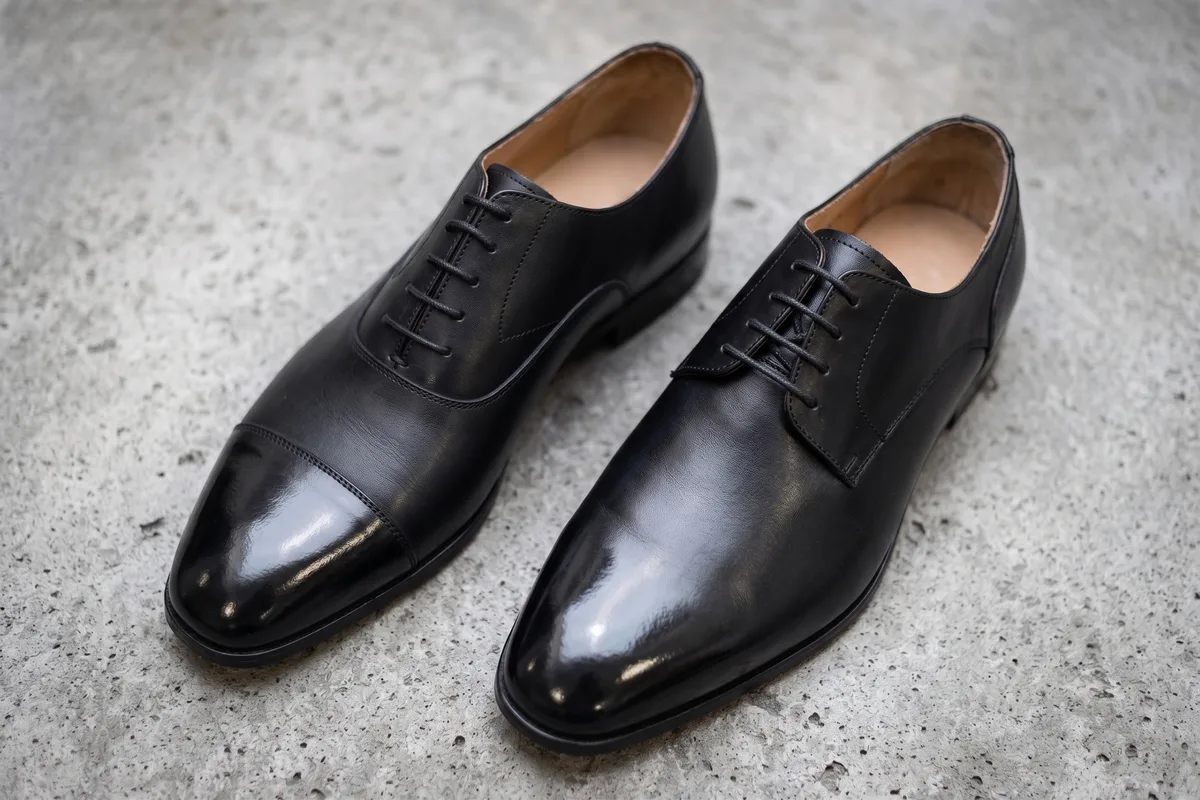
The modern business shoe descends from two lines of very different character. One came from the court. The other came from the field.
Closed lacing is called the Balmoral. The name traces to Balmoral Castle in Scotland, bought by Queen Victoria in 1852, and to a shoe said to have been made for Prince Albert to wear there — a shoe that could take the grounds of a private estate and still be worn indoors among company. In Britain the same construction is called the Oxford, a name generally traced to the “Oxonian” half-boot worn at the university in the early nineteenth century. Either way, closed lacing was born in a world where nobody had far to walk.
Open lacing is called the Blucher, after Gebhard Leberecht von Blücher, the Prussian field marshal of the Napoleonic wars. Long marches swelled his soldiers’ feet, and the military boots of the day were slow to get on and off. A shoe that could be pulled on quickly and adjusted widely over the instep — that, by tradition, is where the structure came from.
A shoe from the court and a shoe from the army. That difference of origin is still, today, the order of formality.
Closed and Open Lacing: The Structure That Sets the Order
The lace panels — the sections carrying the eyelets — are joined to the vamp, the leather covering the top of the foot, in one of two ways. That is the whole of the difference. And that alone settles which shoe outranks which.
The Structural Difference
In closed lacing, the panels are sewn underneath the vamp. Loosen the laces and they still will not open far; the instep reads as one continuous surface. In open lacing the panels sit on top of the vamp. Loosen the laces and they flare apart.
Why Closed Lacing Ranks Higher
Most explanations state the order and stop there. But an order without a reason leaves you unable to judge a shoe you have never seen before. The reason is in the structure itself.
Formality is the removal of elements, the closing of surfaces, the quieting of outline. Closed lacing produces an unbroken plane across the instep and reduces both line and ornament. Open lacing adds a component that rests on the surface, which means more lines and, in the range of the opening, a lingering suggestion of movement. The less movement a garment suggests, the higher it ranks — a principle that runs through formal dress entirely, and behaves the same way in a shirt collar and in a jacket lapel.
So what is worth committing to memory is not the names but the principle. Is the surface closed or open? Is there little ornament or much? Those two questions will place any shoe you encounter.
Where Open Lacing Wins
None of which makes open lacing the lesser shoe. For a man with a high instep, for feet that swell by late afternoon, for a day spent covering distance, that range of adjustment is a decisive practical advantage. If your work is hours of walking, open lacing will keep your posture — and your expression — in better order. The order of formality and fitness for the day’s task are two separate questions.
The Toe: The More Ornament, the Lower the Standing
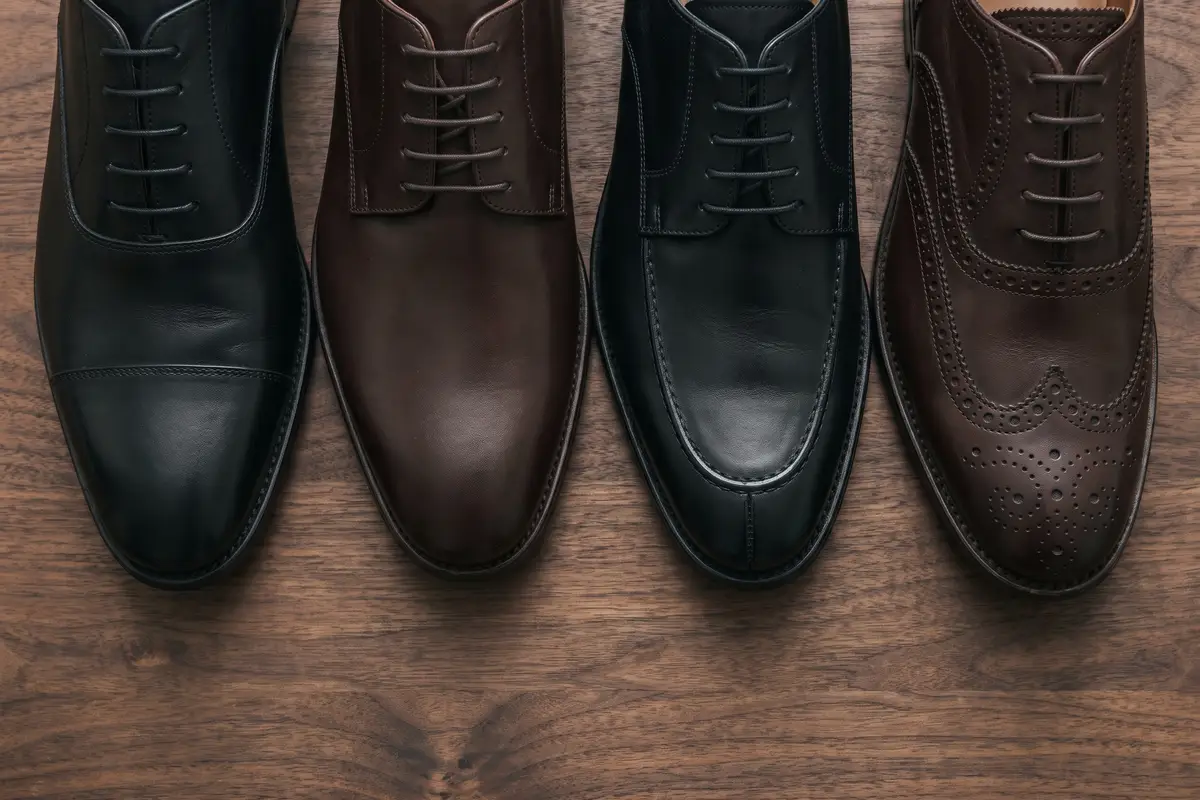
The same principle reads the toe.
Most formal is the cap toe — a single straight seam across the toe and nothing else. Then the plain toe, without even that seam. Those two are the range you can take into a decisive room. An apron front adds a U-shaped seam over the toe; a wingtip adds W-shaped seams and punched perforations, the brogueing. As the seams multiply and the holes appear, the shoe moves toward the casual — all of it measurable on the single scale of how much ornament is present.
With that understood, the answer for the decisive pair has not changed in many years. Black, closed lacing, cap toe. An appointment to a new role, a negotiation that matters, a ceremony, a funeral. With that pair in the wardrobe, there is almost no occasion where the floor lets you down. Master it completely, and only then move on to choosing brown, or open lacing, or a wingtip by deliberate exception.
Construction Decides Both Lifespan and Standing
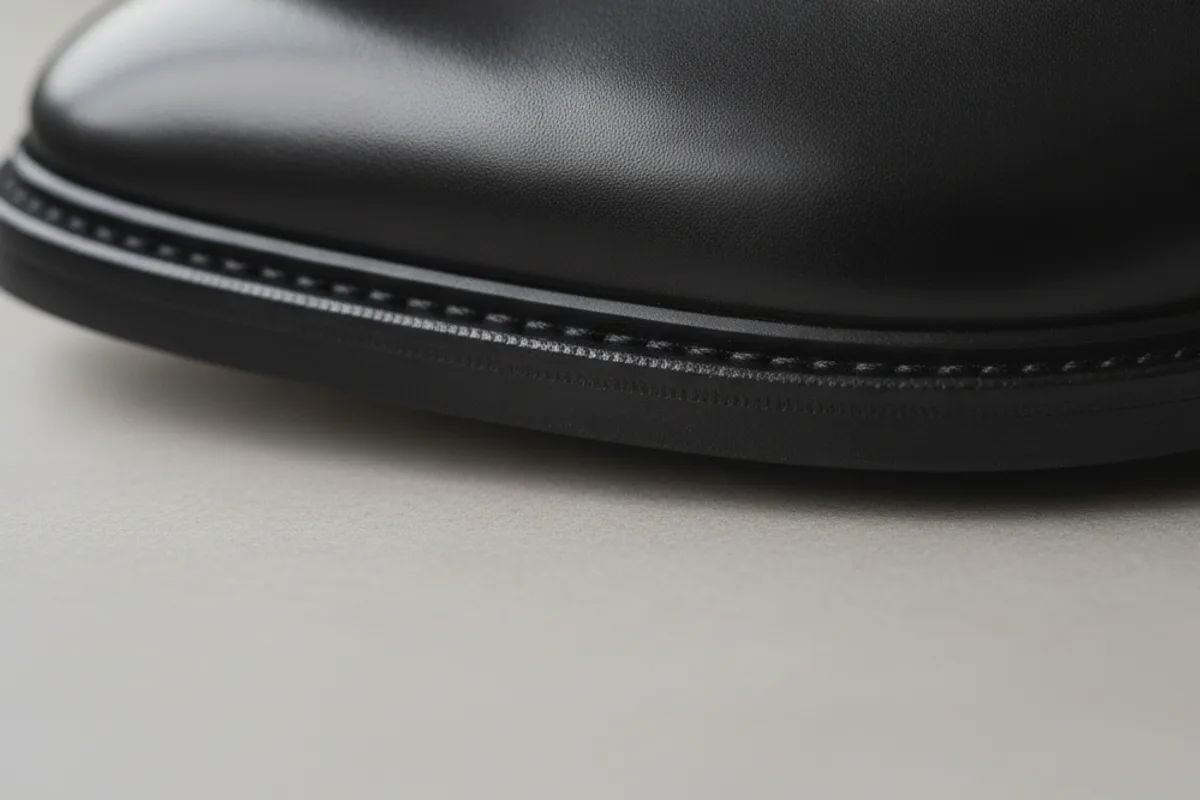
Two shoes of the same shape but different make are different shoes. And the difference declares itself with some cruelty a few years into wearing them.
Goodyear welting joins the upper and the insole through a narrow strip of leather called the welt, then stitches the outsole to that welt. The doubled structure is robust, and when the outsole wears through it can be unpicked and replaced. Blake stitching sews the upper directly to the outsole, which makes for a lighter, more flexible shoe. Cemented construction bonds them with adhesive: inexpensive and light, but not built on the assumption that the outsole will ever be changed.
Here is a fact that rarely gets told. Neither of the two great constructions carries the name of its inventor. The welting machine was completed around 1875, but the men who developed it were engineers led by Auguste Destouy; Charles Goodyear Jr. was the man who acquired the patents and built the business. The same is true of Blake: Lyman Blake patented the sole-sewing machine in 1858, and Gordon McKay bought it, improved it and carried it to the world — which is why much of the trade still calls it the McKay. What survived was not the name of the man who made the thing, but the name of the man who delivered it.
From years of fitting and selling at a luxury menswear shop, I can say the surest measure of whether a price is justified is the construction. A shoe you can repair and keep wearing is closer to an asset than to a purchase. Counted in decades, a good pair often costs less than a run of cheap ones replaced again and again.
And there is something more important than the arithmetic. Given the same budget, concentrating it into one better pair returns far more, in the single currency of standing, than spreading it across several cheaply made ones. What shows at the floor is not how many pairs you own but the quality of the one you have on. Fewer, better. In dressing, few decisions pay so plainly.
Size and Width: The Precondition for Standing
The world of dress tends to wave this away, but the fastest-growing demand of all is for shoes that do not tire the feet and do not hurt. That reality should not be ignored. Quite the opposite: fit is the precondition for standing.
A shoe that does not fit changes how you walk. A changed walk changes posture, and changed posture changes the face. However high a shoe’s standing, a man walking through pain looks like a man walking through pain. A shoe in the wrong size voids whatever standing it had.
What matters here is that a shoe is measured on two axes: length and width. Length is straightforward. Width is the girth around the widest part of the foot, the ball. Conventions differ by country — British makers commonly mark widths E, F and G, American ones D, E and EE — but the point holds everywhere: two shoes of the same length in different widths are different shoes.
And when a man says a shoe does not fit, what is usually wrong is not the length but the width. Escape a tight ball by going up in size and you end up in a shoe longer than you need. The heel lifts, the foot slides forward with each step, the toes jam at the end. A great many people spend a lifetime in shoes that do not fit, convinced the problem is length.
Only when length and width are both right does the foot come to rest inside the shoe. The heel stays put, the instep is held in the right place, the toes stay free. At that point the way you walk changes. Fit is not merely a matter of comfort. A foot that does not move inside the shoe becomes a steady stance and a steady stride, and from the outside that reads as standing. Only when length and width agree does a shoe begin to confer anything at all.
Beyond that, the toes need a little allowance ahead of them, but never settle for slack. A leather shoe is an instrument for securing the foot with laces: the point is not to cinch down a loose shoe, but to fasten a shoe that fits with a light pull.
How the Best-Dressed Men Treat Their Shoes
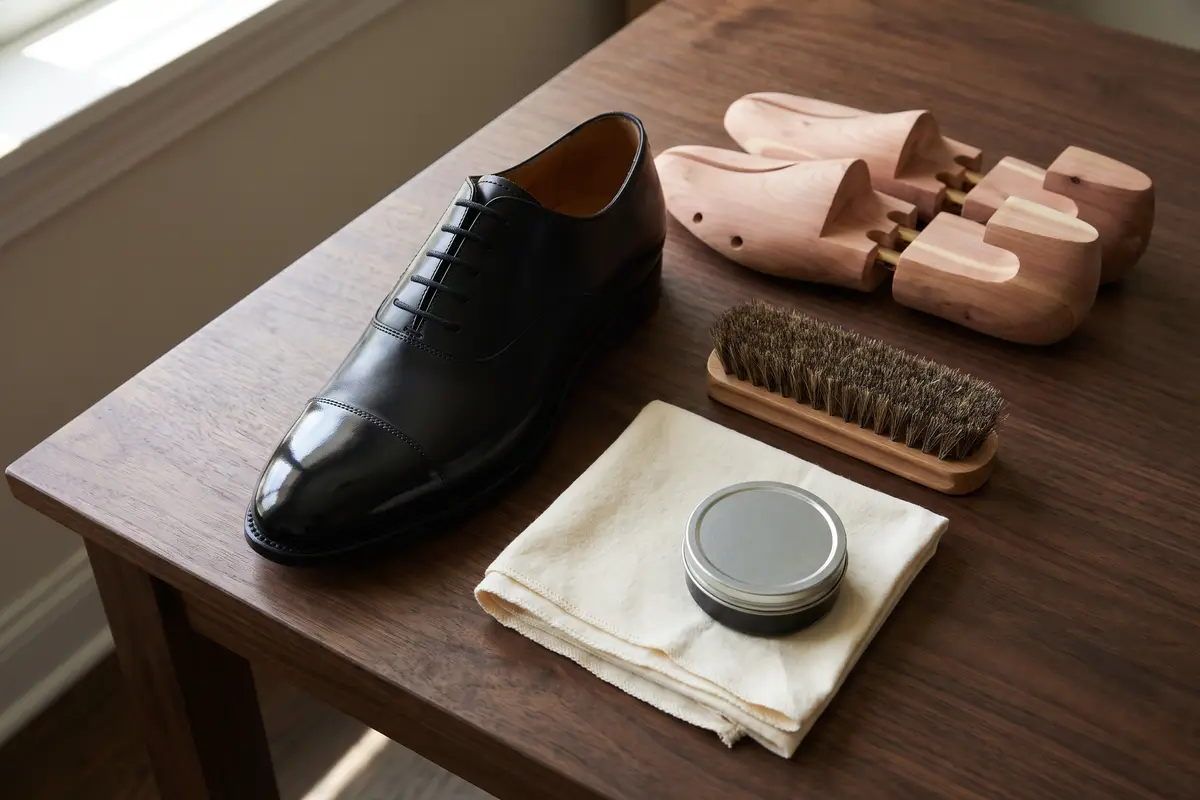
From many years of watching, here is what the men whose dress carries best have in common.
First, they never wear the same pair two days running. A pair of feet is generally said to give off around a cupful of moisture in a day, and that moisture takes time to leave the leather. Wear a pair for a day, then rest it for at least a day — building a rotation of three pairs or more is the single most effective habit for making shoes last.
Second, shoe trees go in the moment the shoes come off. Leather curled by walking is returned to its shape while it is still warm and damp. A tool costing a few pounds transforms the life of a shoe costing hundreds.
Third, order matters more than frequency. Brush off the dust, feed the leather with a cream about once a month, buff it with a dry cloth. That is the whole of the routine. There is no need to bring the entire shoe to a mirror finish; overdo it and the effect turns flashy.
The toe, however, is the exception. Bring the toe up carefully and a quiet light appears at the floor that lifts the whole of what you are wearing. Restrained everywhere, beautiful at the toe. That balance is the heart of shoe care.
Fourth, judge a shoe’s life by what can be repaired and what cannot. This is where most people go wrong. The outsole can be replaced when it wears. Heel pieces can be renewed as often as you like, and a worn lining can be relined. Even the creases in the upper settle down once the leather is fed. Nearly every kind of damage can be repaired.
Only one thing cannot. When the valley of a crease splits and the fibers of the leather themselves break, nothing brings it back. Repairable or not repairable: judge on that one question and you will neither retire a shoe with plenty of fight left in it, nor walk into a decisive room in one whose life is over.
And what the experienced eye is reading is not the price. Whether the heels have worn evenly. Whether the toe carries a deep scuff. And whether the edge of the sole — the narrow band standing proud of the upper — has been left dull and furred. Every one of them records what a man did after he put the shoes on. Anyone who knows that puts his own heels, toes and sole edges in order first.
In Closing: The Floor Decides the Credit of the Whole
The essence of a shoe lies in being the place nobody believes is being looked at. Know the two origins, court and army. Know the principle of ornament that governs lacing and toe. Measure lifespan by construction. Add a fit where length and width agree, and the floor becomes an instrument that quietly accumulates credit.
One last thing, from my own experience. Men who have spent a long time in this world often take the measure of someone before they see him, by the sound of his footsteps. A well-kept shoe that fits lands with a short, dense sound. A shoe that does not fit, or whose sole is tired, sounds lighter, somehow hollow. A lifting heel means the foot lands twice rather than once, and a loosened sole scatters the sound. To say you can hear the condition of a man’s shoes as he comes down a corridor may sound like an exaggeration; to anyone who has watched the floor for long enough, it is not a rare sensation at all.
Some people lose ground because of how they dress, and never notice. Most of the time, the loss is happening somewhere they never look — and in a sound they never hear.
The confidence you wear wins the game.
Frequently Asked Questions
Closed lacing — the Oxford, or Balmoral — is the more formal of the two. Its lace panels are sewn underneath the vamp, so the instep reads as one continuous, unbroken surface with fewer lines and less ornament. The principle that closing a surface and removing incident raises formality runs through shirt collars and jacket lapels as well.
Where standing matters most, a black cap-toe Oxford is the surest choice. Open lacing sits a step lower because the panels rest on top of the vamp, adding lines and leaving the suggestion of movement in the adjustable opening. When in doubt, choose closed lacing.
More often the mismatch is width rather than length. Escaping a tight fit by going up in size leaves you in a shoe that is longer than you need, so the heel lifts, the foot slides forward with every step, and the toes jam. Only when length and width are both right does the foot come to rest inside the shoe.
A black cap-toe Oxford with closed lacing. Its single straight seam across the toe is the least ornamented design there is, and it carries you through an appointment to a new role, a decisive negotiation, a ceremony and a funeral alike. Master that pair before choosing brown, open lacing or a brogue by deliberate exception.
Goodyear welting joins the upper and the outsole through a narrow strip of leather called the welt, giving a double structure that is robust and lets the outsole be replaced when it wears through. Blake stitching sews the upper directly to the outsole, making a lighter, more flexible shoe. A shoe you can repair moves closer to an asset than to a purchase.